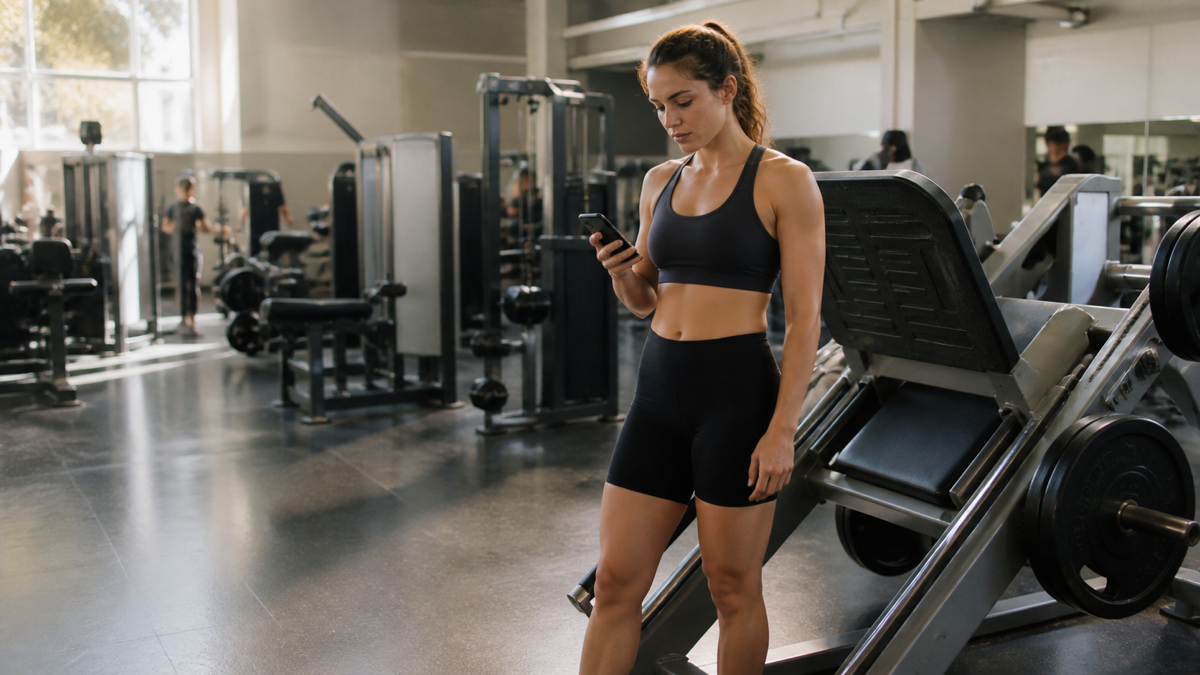
You arrive at the gym with a water bottle, a saved playlist, and one unresolved detail: what are you actually supposed to do with all that equipment?
You do not need to recognize every machine before you begin. If you want basic gym exercises for beginners, start with these eight: leg press, dumbbell Romanian deadlift, chest press, seated row, lat pulldown, machine shoulder press, step-up, and dead bug. Together, they cover your legs, hips, chest, back, shoulders, and trunk.
You also do not need to perform all eight in one workout. Learn two or three at a time, use a light resistance, and stop each set while your movement is still controlled. The goal of your first visits is to build a small library of exercises you know how to set up and repeat.
Eight beginner gym exercises at a glance
The table gives you eight practical exercises to do in the gym for beginners, but the exact machines will vary. Read the instruction label on the model in front of you and ask a staff member to show you the adjustments if anything is unclear.
| Exercise | Main areas trained | Beginner starting point | Easy swap |
|---|---|---|---|
| Leg press | Thighs, glutes, hips | Light machine resistance | Bodyweight squat to a bench |
| Dumbbell Romanian deadlift | Hamstrings, glutes, back-body control | Practice the hip hinge without weight | Seated leg curl |
| Chest press | Chest, shoulders, triceps | Seated machine | Wall or incline push-up |
| Seated row | Upper back, shoulders, biceps | Chest-supported machine | Light cable row |
| Lat pulldown | Back, shoulders, arms | Neutral or comfortable overhand grip | Resistance-band pulldown with a secure anchor |
| Machine shoulder press | Shoulders, triceps | Back-supported machine | Skip it if overhead movement is uncomfortable |
| Step-up | Thighs, glutes, balance | Low platform with nearby support | Supported split squat |
| Dead bug | Trunk control | Move one heel at a time | Heel slide |
An exercise earns a place on a beginner list when you can adjust it to your body, understand what is moving, and repeat it without rushing. “Easy” does not mean effortless. The best easy gym exercises for beginners are challenging enough to feel like work while leaving you in control of the next rep.
Machines and free weights can both work. The 2026 American College of Sports Medicine position stand found that equipment type did not consistently change results for the average healthy adult. A machine may reduce the balance and setup demands of a movement. Dumbbells may offer more freedom to find a comfortable path. Choose the version you can perform well and access regularly.
How to do the eight exercises
For each new movement, begin with a no-weight or very light test. Try five slow reps, adjust the setup, and only then decide whether to add resistance. A machine number or dumbbell label is information, not a score.
1. Leg press
The leg press trains your thighs and glutes while the seat supports your torso. It is a practical place to learn a squat-like pushing pattern without balancing a weight.
Sit with your back and hips against the pads. Place your feet about hip- to shoulder-width apart and keep your heels down. Bend your knees through a range that feels comfortable while your hips stay in contact with the seat. Press the platform away, stopping before you forcefully lock your knees, then return with control.
Make it easier: reduce the weight or shorten the range. Reset the setup: if your heels lift, your hips curl away from the pad, or your knees hurt.
2. Dumbbell Romanian deadlift
This exercise teaches a hip hinge: your hips travel backward while your knees stay softly bent. It works the hamstrings and glutes and helps you practice moving at the hips without turning every lower-body exercise into a squat.
Learn the pattern before picking up dumbbells. Stand a short step in front of a wall and send your hips back until they tap it. Keep your ribs stacked over your pelvis and your spine long. When that feels steady, hold two light dumbbells close to your thighs, push your hips back, and lower only until you feel tension in the back of your legs without losing your position. Press through your feet and bring your hips forward to stand.
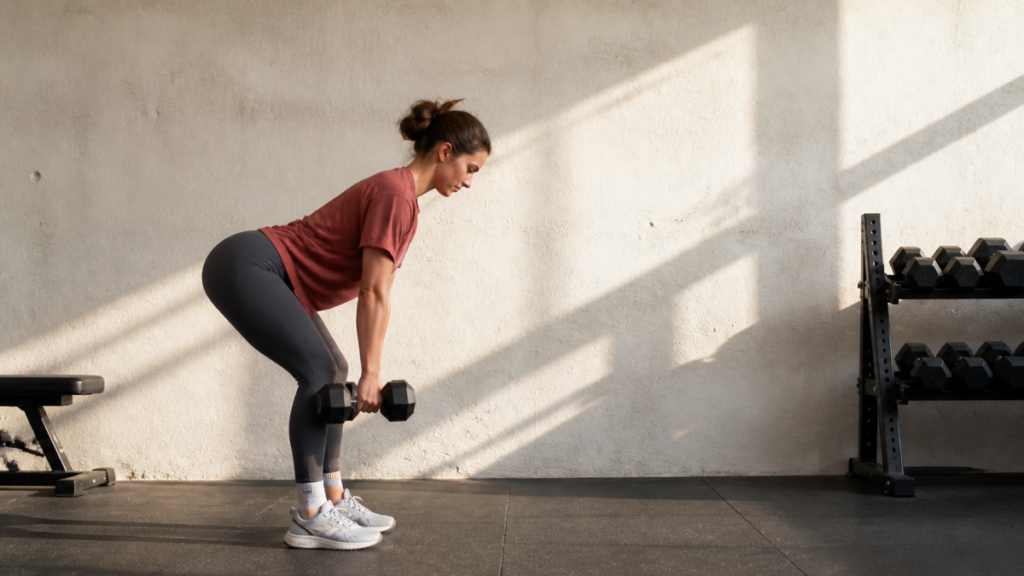
Make it easier: keep practicing the wall hinge or use a seated leg-curl machine instead. Stop the set: if you feel sharp back pain, cannot keep the weights close, or have to jerk them upward.
3. Seated chest press
The chest press is a horizontal pushing exercise for your chest, shoulders, and triceps. The machine version gives you a stable base while you learn the path.
Adjust the seat so the handles begin around mid-chest height. Keep your feet planted, back supported, and wrists in line with your forearms. Press the handles forward without shrugging or letting your shoulders roll away from the pad. Bend your elbows slowly to return through a comfortable range.
Make it easier: lower the resistance or limit the deepest part of the return. Try another option: use a wall push-up if the machine cannot be adjusted to fit you.
4. Seated row
The seated row trains your upper back and arms. It also introduces a basic horizontal pull, the opposite direction of a chest press.
Set the seat and chest pad so you can reach the handles with long arms without rounding forward. Sit tall, keep your wrists straight, and pull your elbows toward your sides. Pause when your hands reach your body, then straighten your arms slowly without letting the weight pull you out of position.
Make it easier: choose a lighter stack setting and use chest support. Lower the weight: if you need to rock backward or snap the handles toward you.
5. Lat pulldown
The lat pulldown is a vertical pull for your back and arms. It can help you learn the same general pulling direction used in a pull-up while the weight stack remains adjustable.
Secure the thigh pad so it holds you comfortably in the seat. Take a grip that does not pinch your shoulders or wrists. Keep your torso mostly upright and pull the bar or handles toward your upper chest by driving your elbows down. Let your arms lengthen again without dropping the stack.
Make it easier: reduce the weight or use neutral-grip handles, with your palms facing each other, if available. Avoid: pulling the bar behind your neck or turning the movement into a large backward swing.
6. Machine shoulder press
The shoulder press is a vertical push for your shoulders and triceps. A back-supported machine can make the setup simpler than pressing free weights overhead.
Adjust the seat so the handles start close to shoulder height. Keep your feet down, wrists straight, and back supported. Press upward through the range you can control, then lower slowly. Your ribs should not flare forward to create extra movement.
Make it easier: lower the weight and press only through a range you control. Skip it for now: if reaching overhead is painful or the machine forces you into an uncomfortable position. Your session can still cover the major pushing pattern with the chest press.
7. Step-up
A step-up trains your legs and glutes one side at a time. It also asks for more balance than a leg press, so the height matters more than how impressive the box looks.
Choose a low, stable platform. Place your whole foot on it, lean forward slightly, and press through that foot to stand. Step down with control. Keep a rail or sturdy support within reach, and complete your reps on one side before switching if that helps you stay organized.
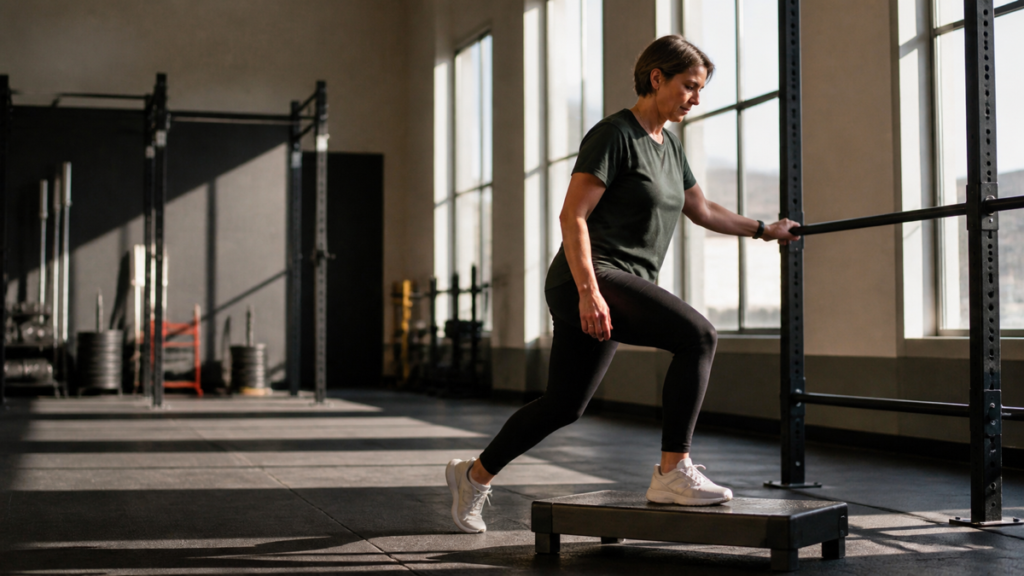
Make it easier: use a lower step, hold support, or practice without added weight. Choose another move: if you cannot keep the working foot planted or step down smoothly.
8. Dead bug
The dead bug trains your trunk to stay steady while your arms and legs move. No cable stack is required; a mat and enough floor space will do.
Lie on your back with your knees bent and feet down. Gently tighten your middle, then slide one heel away and bring it back without your lower back arching farther from the floor. Alternate sides. If that feels steady, lift your knees over your hips and lower one heel at a time.
Make it easier: make the heel slide shorter. End the set: when your back position changes, your neck tenses, or you can no longer breathe comfortably.
How to choose the right starting weight
The right first weight is light enough to let you learn and heavy enough to give you useful feedback. You should not have to guess from the dumbbell rack and defend your choice for the rest of the workout.
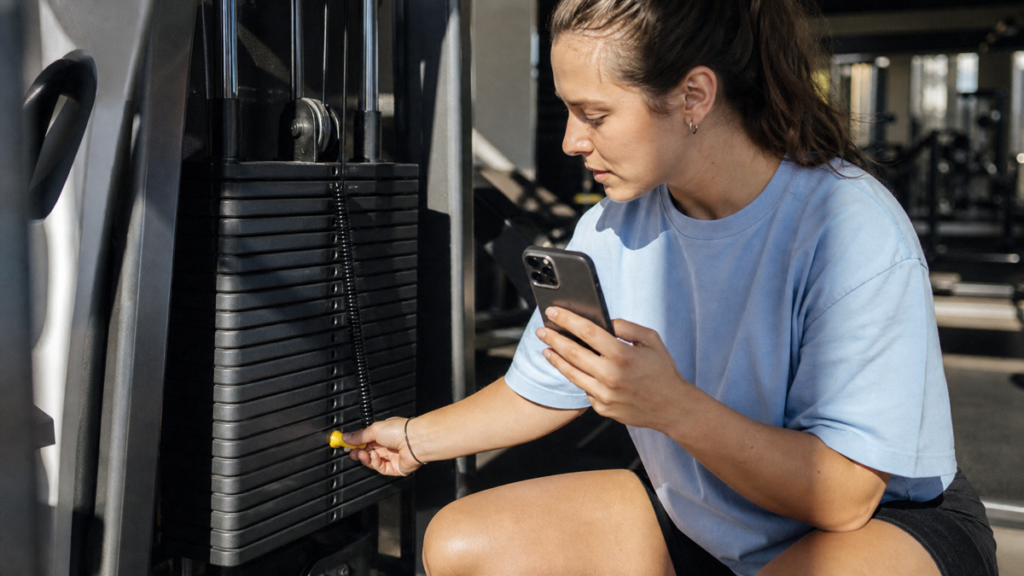
Use this quick check:
- Practice the path without weight or at the lightest useful machine setting.
- Perform five controlled test reps.
- Add the smallest available amount only if the movement still feels very easy.
- For your first work set, stop while you could still complete about two or three clean reps.
- Record the machine, seat setting, weight, and reps for next time.
The last few reps can feel demanding, but your range and speed should remain recognizable. If you hold your breath, bounce the weight, twist, or shorten the movement without meaning to, reduce the load and try again.
Training to the point where you cannot complete another rep is not a beginner requirement. Current ACSM guidance emphasizes that advanced methods and training to momentary failure are optional for the average healthy adult. A repeatable set is more useful than one dramatic set that makes the rest of the session fall apart.
Stop an exercise if it causes pain rather than ordinary muscular effort. End the workout and get appropriate help if you feel faint or dizzy, develop chest pain or pressure, have an irregular or racing heartbeat, or become unusually short of breath. If you have an injury, ongoing pain, a chronic condition, or need pregnancy or postpartum modifications, get individualized guidance on exercise choice and load.
How to turn the list into a simple first session
Eight exercises are options, not an eight-part entrance exam. For a first practice session, choose five:
- One knee-dominant leg exercise: leg press or step-up.
- One hip or hamstring exercise: Romanian deadlift or leg curl.
- One push: chest press or shoulder press.
- One pull: seated row or lat pulldown.
- One final move: the second pull, dead bug, or another exercise you want to practice.
Begin with five minutes of easy walking or cycling so your breathing and heart rate rise gradually. Complete one light set of 6–10 controlled reps per exercise, or 4–6 reps per side for the dead bug. Rest until you feel ready to repeat good form; you do not need to turn the strength section into a race.
Want the machines, order, sets, and progression already chosen? Use this six-machine gym beginner workout for your first few visits.
If the gym is packed, move to the next exercise instead of guarding one machine like it is the last seat on a train. Keep the same movement category when you swap: row for row, press for press, and lower-body exercise for lower-body exercise. When no equipment is free, these bodyweight exercises for beginners give you controlled alternatives.
Over time, work toward training all major muscle groups on at least two days each week, as current U.S. physical activity guidance recommends. That target does not require a complicated split. Two short full-body sessions can be a practical starting structure.
If you need to fit strength and cardio into a busy week, this guide to how to start working out gives you a realistic first schedule.
Common mistakes when learning gym starter exercises
- Trying every exercise in one visit. Learn a small set, record the settings, and add a new movement later.
- Copying someone else’s machine position. Their seat number suits their body. Reset every machine before you use it.
- Choosing weight before learning the path. A light test gives you better information than the number on the stack.
- Treating discomfort as proof that it works. Muscles can feel challenged; joints should not feel sharp, pinched, or unstable.
- Changing the exercise every week. Repeating a few movements helps you improve the setup and notice when the same weight feels more controlled.
- Forcing the full range shown online. Use the largest comfortable range you can control on the equipment available to you.
- Adding weight to fix a boring session. You can improve a rep by moving with more control before making it heavier.
FAQ
What are the best gym exercises for beginners?
The best choices cover the main movement directions and are easy to adjust. A leg press, Romanian deadlift or leg curl, chest press, row, lat pulldown, and a simple trunk exercise create a useful base. The specific equipment matters less than controlled technique and regular practice.
How many exercises should a beginner do at the gym?
Four to six exercises are enough for a focused first strength session. Choose a lower-body movement, a push, a pull, and one or two supporting exercises. More movements are not automatically more effective if the extra decisions make your form rushed.
Should beginners use machines or free weights?
Either can work. Machines may feel simpler because they guide the path and support your body. Free weights allow more movement choices and can help you practice balance and control. You can also combine them, such as a machine press with a light dumbbell hip hinge.
Do women need different beginner gym exercises?
No separate list is required simply because you are a woman. Exercise choice should reflect your goals, current ability, comfort, health, and available equipment. Individual modifications matter more than a gender label on a workout.
How often should a beginner repeat these exercises?
Two nonconsecutive full-body strength days can be a practical start. Repeat the same core movements long enough to learn them, then change an exercise when the equipment does not fit, the movement is uncomfortable, or your goals call for a different option.
Choose your first three exercises
Save the leg press, chest press, and seated row before your next visit. Find each machine, ask for one setup check if you need it, and complete a light practice set. That is enough for Day 1.
Once those three feel familiar, add one lower-body or pulling movement. Your list of gym starter exercises will grow because you practiced them, not because you memorized the entire gym floor from the doorway.