Category: GYM

  • Workout Routines for Beginners at Home: Easy Weekly Plan

    Workout Routines for Beginners at Home: Easy Weekly Plan

    You finally have a quiet half hour at home. Then you spend 20 minutes comparing workout videos, reject three that open with burpees, and run out of time before you choose one.

    That is not a motivation problem. It is a planning problem.

    Here is the simple answer: start with two 20–30-minute full-body strength workouts on nonconsecutive days, add one or two short cardio sessions, and keep at least one easier day between demanding sessions. Workout A and Workout B below tell you exactly what to do. Repeat the same week until it feels familiar, then progress one detail at a time.

    The most useful workout routines for beginners at home remove decisions without demanding a perfect week. This one gives you a full version, a short version, and a clear way to return after a missed day.

    This beginner exercise routine at home is intentionally flexible. A packed week can use the short versions. A calmer week can include a second round or more cardio. The plan bends before it breaks.

    Workout routines for beginners at home: your first week

    Use this as your first weekly template. Move the days to fit your calendar while keeping the two strength sessions apart.

    DaySessionTimeYour focus
    MondayStrength Workout A20–30 minutesSquat, push, pull, hips, and trunk
    TuesdayEasy or moderate cardio15–25 minutesBrisk walk, low-impact dance, bike, or marching
    WednesdayRest or easy mobility5–10 minutes optionalGentle movement that leaves you refreshed
    ThursdayStrength Workout B20–30 minutesSingle-leg work, hinge, push, pull, and trunk
    FridayRestNo make-up workout required
    SaturdayEasy or moderate cardio20–30 minutesChoose an activity you can repeat
    SundayRest and plan5 minutesSet out equipment and choose next week’s times

    This starter week includes two strength days and 35–55 minutes of planned cardio. It is a starting point, not the full public-health target. Current U.S. and World Health Organization guidance recommends that adults work toward 150–300 minutes of moderate-intensity aerobic activity a week, or 75–150 minutes of vigorous-intensity activity, plus muscle-strengthening activity on at least two days. If you are currently inactive, start with smaller amounts instead of trying to force the whole target into Week 1.

    Treat the 35–55 minutes as the starting structure in this sample week. When that feels manageable, you could add five minutes to one cardio session or add one short brisk walk, then repeat that version before changing anything else. There is no deadline for reaching the wider range.

    You can also collect aerobic minutes in shorter blocks. A 10-minute brisk walk after lunch and another after dinner are still useful pieces of the same week.

    Set up your space before the workout starts

    A beginner exercise program at home should not depend on a perfect room or a cart full of equipment. For these sessions, gather:

    • a stable chair placed on a non-slip surface, preferably against a wall;
    • a clear patch of floor;
    • a folded towel or mat if floor work feels better with padding;
    • one light resistance band, dumbbell, or securely closed backpack for rows and hinges;
    • a visible copy of your routine, either on a screen or on paper.
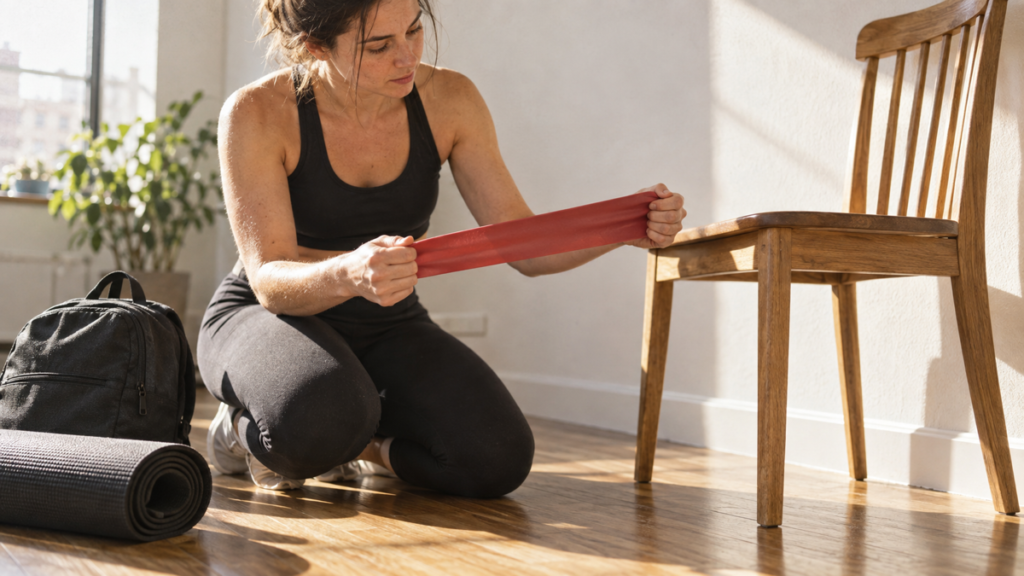
    Woman inspecting a resistance band beside a stable chair, zipped backpack, and rolled exercise mat.

    Check the floor for bags, toys, cords, and slippery rugs. Check the chair before leaning on it. If you use a backpack, inspect the seams and zipper and pack it so the contents cannot shift or break. If you use a band, check it for damage and attach it only to a secure point designed to hold the pulling force.

    No equipment today? Use the easier bodyweight options in the tables. Because a true pulling movement is difficult without resistance, add a band or a light household load when you can. If you want a plan built specifically around no-equipment training, use this four-week bodyweight plan.

    How to run each strength session

    Use the same order for both workouts so the process becomes automatic.

    1. Warm up for 3–5 minutes. March, walk around the room, circle your shoulders, and rehearse the first two exercises through a small comfortable range.
    2. Complete one round. Do each exercise once in the listed order. Rest for 30–90 seconds, or longer if you need it to regain steady breathing and control.
    3. Choose whether to repeat. One round is enough for your first sessions. Add a second round when the first one feels organized and you have time.
    4. Keep the effort controlled. The final reps may require focus, but stop when you feel you could still do a few more with the same range and pace.
    5. Ease out of the session. Walk slowly around the room and let your breathing settle rather than dropping straight onto the sofa after a hard set.

    Stop an exercise if you feel pain, dizziness, faintness, chest pressure, unusual shortness of breath, or you feel unwell. If a movement simply feels awkward, reduce the range or resistance and try the listed alternative. If it still does not suit you, skip it.

    Strength Workout A: learn the basic patterns

    Complete 6–10 controlled reps of each move unless the table gives a per-side target. Start with one round.
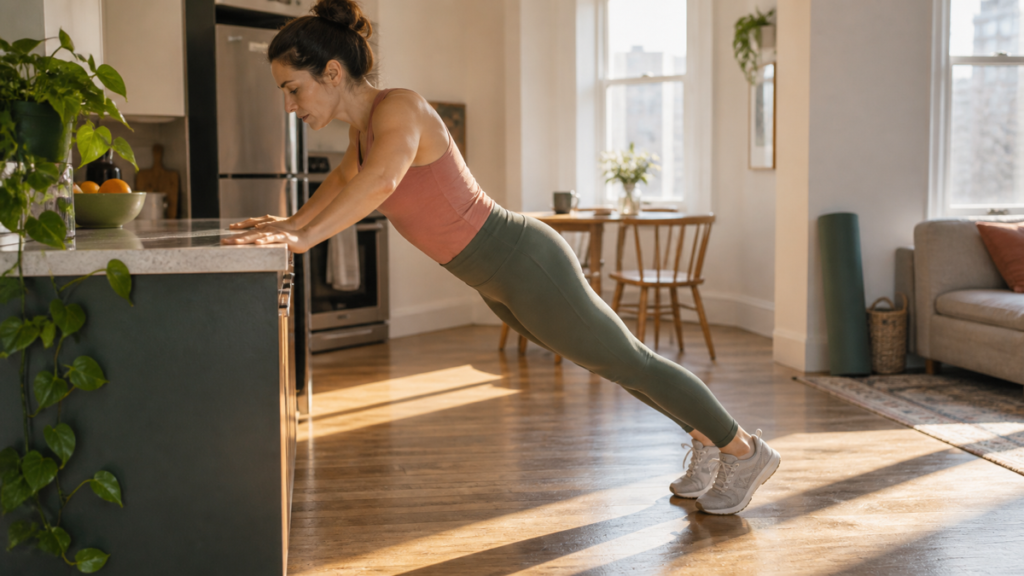
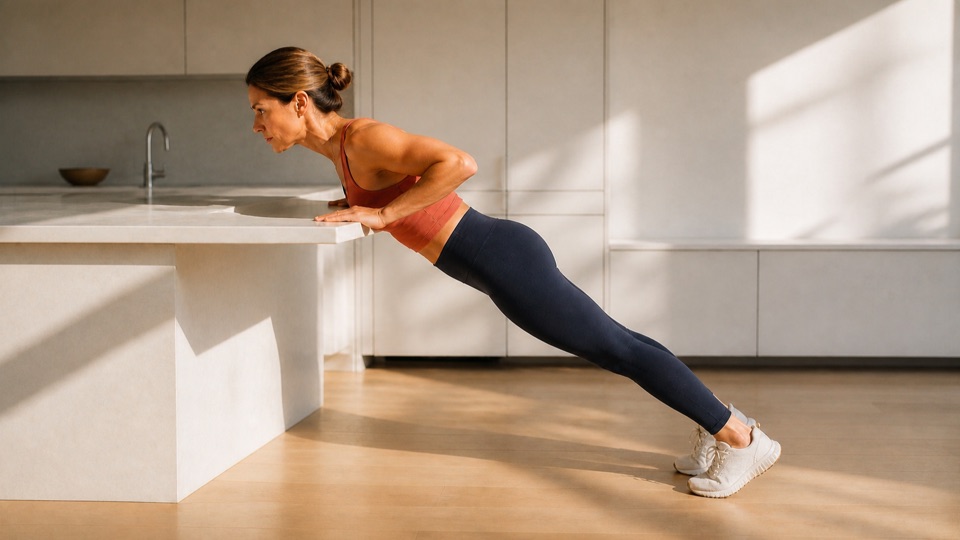
    Beginner performing a controlled counter push-up with her body aligned from head to heels.
    ExerciseTargetSimple setup cueEasier or equipment-free option
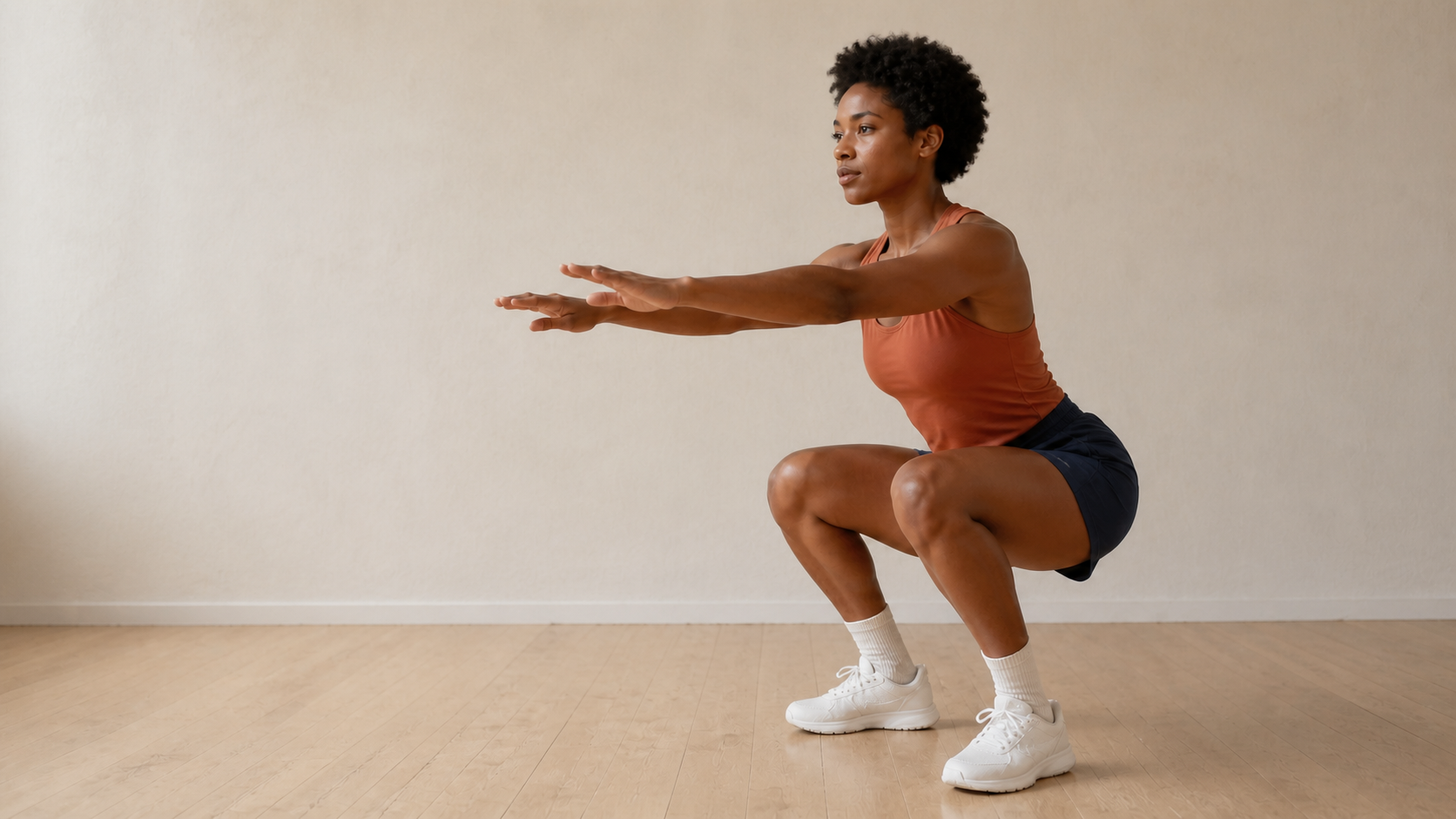
    Chair squat6–10Tap the chair lightly, keep your feet down, then standUse a higher chair or a smaller range
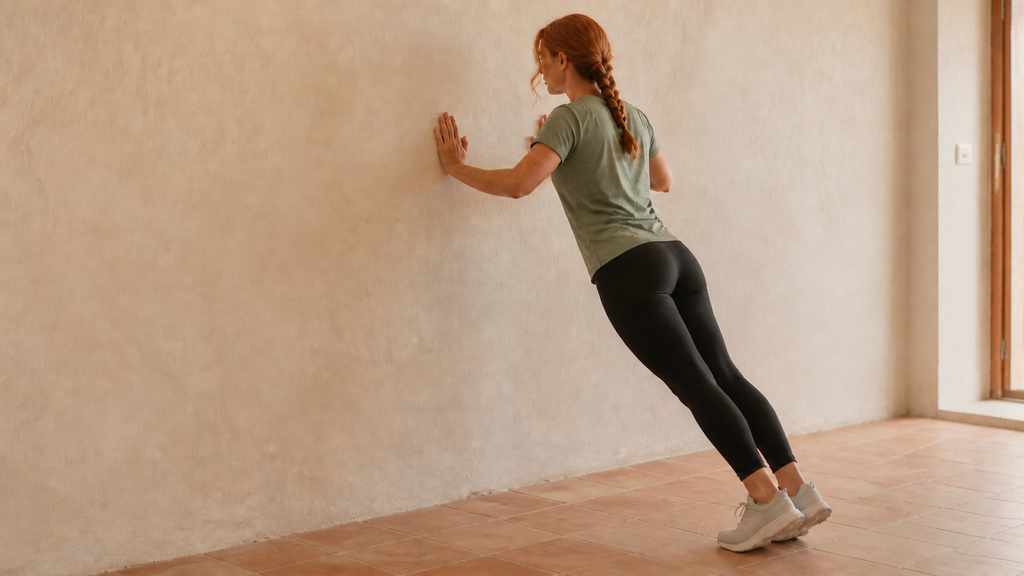
    Counter push-up6–10Use a stable counter and move your body as one lineUse a wall and stand closer
    One-arm backpack or dumbbell row6–10 per sideSupport one hand on the chair and pull toward your ribsUse a very light load; if none is available, do a prone W raise
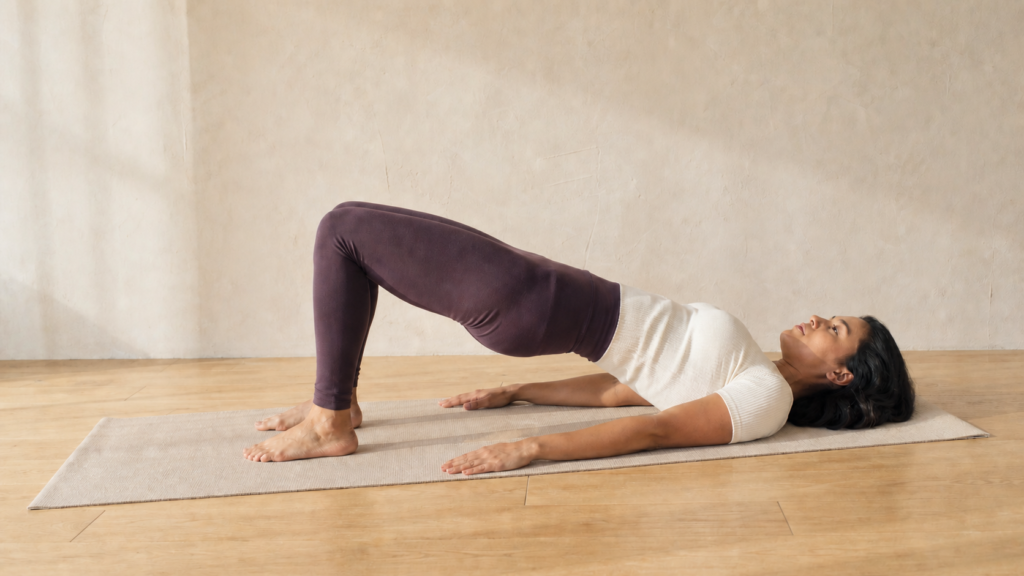
    Glute bridge8–12Press through your feet and lift only as high as you can without archingUse a smaller range
    Dead bug heel slide5–8 per sideSlide one heel away while your trunk stays steadyMake the slide shorter

    Move slowly enough to notice your position. You are learning five patterns, not trying to beat the timer. If one round takes 12 minutes and feels like plenty, it is plenty.

    Strength Workout B: change the challenge, not the whole plan

    Workout B uses similar movement categories with a few different positions. That gives you variety without making every session feel brand new.

    ExerciseTargetSimple setup cueEasier option
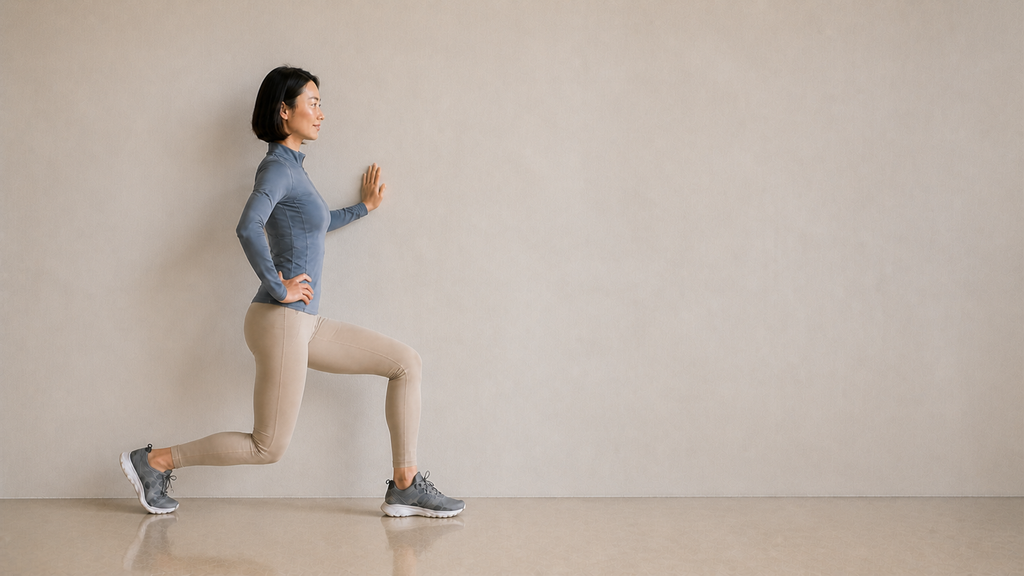
    Supported split squat5–8 per sideHold a wall, keep your feet on two separate tracks, and use a comfortable depthMake the movement shallower
    Backpack or dumbbell hip hinge6–10Send your hips back and keep the load close to your legsPractice the hinge without a load
    One-arm floor press6–10 per sidePress one light dumbbell above your chest while your upper arm is supported by the floorRepeat the wall or counter push-up
    Supported one-arm row6–10 per sideKeep your torso steady and lower the load with controlUse a lighter backpack or dumbbell
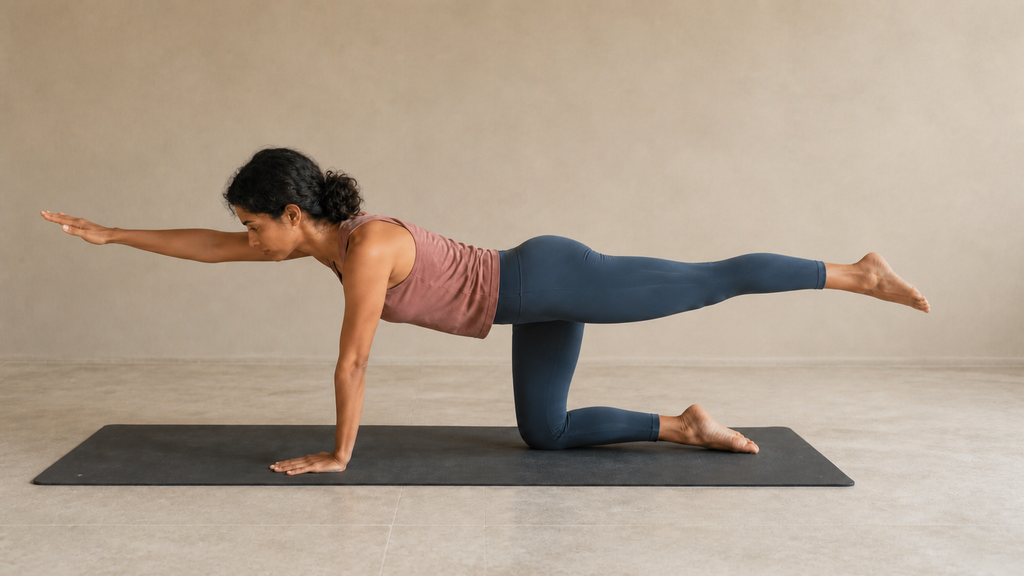
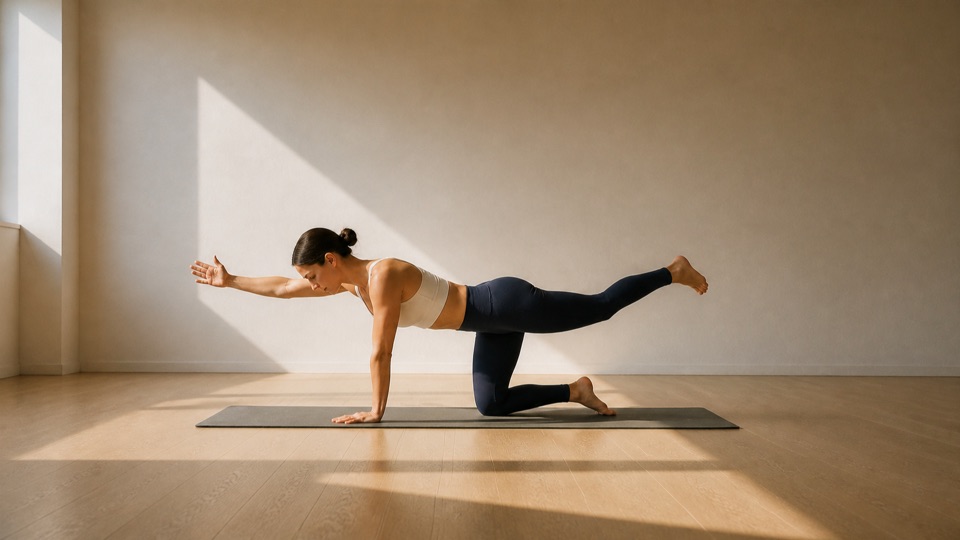
    Bird dog5–8 per sideReach long while keeping your hips levelMove one arm or one leg at a time

    If getting to the floor is not practical, repeat the standing push-up from Workout A and replace the bird dog with a slow standing knee lift while holding the chair. A useful plan works with the space you have and the movements you can manage today.

    Need more help with setup and exercise versions? This guide to bodyweight exercises for beginners explains the core movements in more detail. Keep the weekly structure from this article; use that exercise guide only when you need a form cue or swap.

    Add cardio without turning every day into a hard day

    Strength and cardio have different jobs in this fitness routine for beginners at home. Keep your strength days focused on controlled resistance. Use walking, dancing, cycling, stair walking, or low-impact marching for your aerobic sessions.
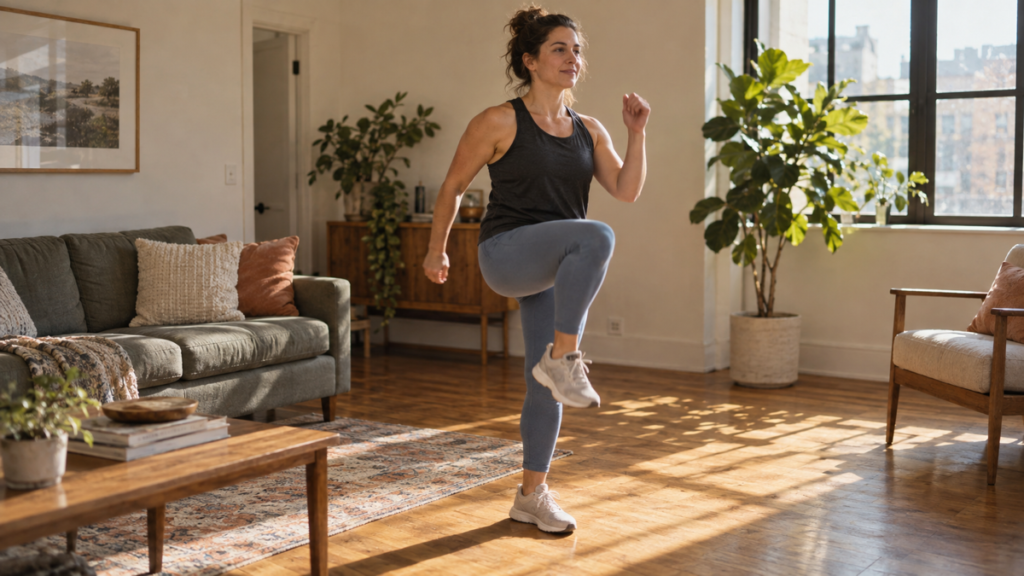
    Woman doing low-impact marching cardio on a clear living-room floor at a comfortable effort.

    The talk test is a simple way to judge cardio effort:

    • Easy: you can speak and sing comfortably.
    • Moderate: you can talk, but singing would be difficult.
    • Vigorous: you can say only a few words before pausing for breath.

    Beginners do not need to chase vigorous effort. An easy or moderate pace is easier to repeat and leaves room to learn how your body responds. Add five minutes to one cardio session when the current duration feels manageable. Use the talk test for everyday walks: if you can talk but not sing, those minutes can count toward your moderate-intensity total. Easier walking still has a place in your day; it simply is not part of the 150–300-minute moderate-intensity target.

    Turn it into a short morning routine

    A morning workout can solve one problem: fewer events have had time to hijack your calendar. It is not automatically more effective than training later. The best time is the one you can use with reasonable energy and repeat.

    For a 10–12-minute morning exercise routine for beginners at home, use this version:

    1. March and move your shoulders for 2 minutes.
    2. Do the first three exercises from Workout A or Workout B for 6–8 minutes.
    3. Walk slowly and breathe at an easy pace for 2 minutes.
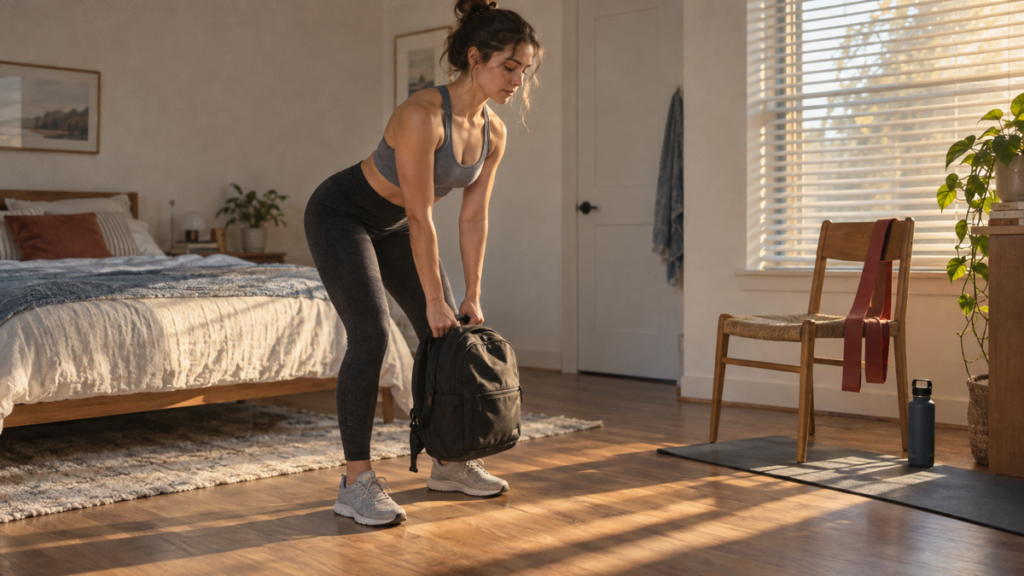
    Beginner doing a controlled backpack hip hinge during a short morning workout in her apartment.

    Complete one set per exercise and stop there. On the next strength day, use the other workout. If you feel stiff in the morning, spend longer warming up and use a smaller range for the first few reps.

    Make the start almost boringly easy: place the chair, band, and routine where you will see them the night before. For downstairs-neighbor-friendly cardio, swap jumps for quick marching, step-touches, or a brisk walk.

    Progress your beginner workout program at home

    Do not change the routine simply because the internet produced a shinier one. Repeat it long enough to learn the movements and compare like with like.

    When both strength workouts feel controlled and you recover comfortably, choose one progression:

    • add 1–2 reps to one or two exercises;
    • add a second round;
    • increase the range slightly;
    • slow the lowering part of a rep;
    • add the smallest practical amount of resistance;
    • add five minutes to one cardio session.

    Keep the other variables steady. Adding reps, a round, weight, and another workout day at once makes it hard to tell which change was useful.

    Write down the exercise version, reps, rounds, and resistance. When you reach the top of a rep range with the same controlled form in two sessions, try one small step. You do not need to train until you cannot complete another rep; current resistance-training evidence does not show that momentary muscle failure is consistently required for the average healthy adult.

    Adjust your beginner workout plan at home after a missed day

    A missed workout does not create exercise debt. Use the smallest fix that keeps the week moving.

    • You missed one strength day: move it to the next open day if that still leaves recovery time, or continue with the next planned session. Do not double both workouts tomorrow.
    • Your week shrank overnight: keep one round of Workout A and one round of Workout B. Let optional mobility go first.
    • You have only 10 minutes: do the morning version or one round of three movements: one lower-body move, one push, and one pull.
    • You missed a full week: return with one round and your previous easy resistance. Add the second round again after the routine feels familiar.
    • You slept badly or feel unusually drained: use a walk, easy mobility, or a shorter session instead of forcing the hardest version.

    Avoid packing missed sessions into the weekend just to make the calendar look complete. The goal is a repeatable rhythm, not a perfect attendance record.

    Common planning mistakes

    Saving five routines and following none

    Choose Workout A and Workout B for the next two weeks. A short written plan removes the decision that usually eats your workout time.

    Making every day a strength day

    More days are not automatically better. Keep recovery between full-body strength sessions and use cardio or easy movement on other days.

    Treating the first week as the final target

    The sample week is a ramp, not a ceiling. Build your aerobic minutes and strength work gradually as your schedule and recovery allow.

    Progressing because the workout felt familiar

    Familiar does not mean ineffective. First ask whether your reps are controlled, your chosen range feels steady, and you can recover for the next session. Then adjust one variable.

    Using the short option as punishment

    The 10-minute version is a planned tool for busy days. It should not become a rushed attempt to “earn” rest or make up for something you ate.

    FAQ

    What is a good home workout routine for beginners?

    A practical routine includes two nonconsecutive full-body strength sessions, one or two manageable cardio sessions, and easier days between demanding workouts. Start with one round of five strength exercises, repeat the week, and add one small challenge when the current version feels controlled.

    How many days a week should a beginner work out at home?

    Two strength days plus one or two cardio days can be a realistic start. Over time, adults are advised to work toward at least two muscle-strengthening days and 150–300 minutes of moderate-intensity aerobic activity each week, or 75–150 minutes of vigorous-intensity activity. You can build toward those aerobic minutes in shorter sessions.

    What should an exercise regimen for beginners at home include?

    Include lower-body, pushing, pulling, hip, and trunk movements across the strength sessions, plus aerobic activity you can do consistently. The exact exercises matter less than choosing versions you can control, repeating them, and increasing the challenge gradually.

    Can I get an effective workout at home without equipment?

    Yes. Bodyweight and home-based resistance training can improve strength and physical function. Equipment is optional for many movements, although a resistance band or light household load makes pulling exercises easier to include. If you are completely new to exercise and want help choosing a broader starting approach, read how to start working out.

    Is morning the best time to exercise?

    There is no universal best time. Current resistance-training evidence does not show that time of day consistently changes muscle adaptations. Morning is useful when it fits your energy and calendar; lunchtime or evening is equally valid if that is when you can train reliably.

    Should I do the same workout every day?

    You do not need to repeat the same full-body strength workout daily. Use Workout A and Workout B on separate days, place easier activity between them, and repeat the weekly pattern. Consistent practice gives you clearer feedback than random daily workouts.

    Put your first week on the calendar

    Choose two nonconsecutive 20–30-minute blocks for Workout A and Workout B. Add one short cardio session. Then place the chair and your chosen resistance where you can find them without reorganizing the room.

    That is your first week. You can make it longer later. For now, make it easy to begin again.
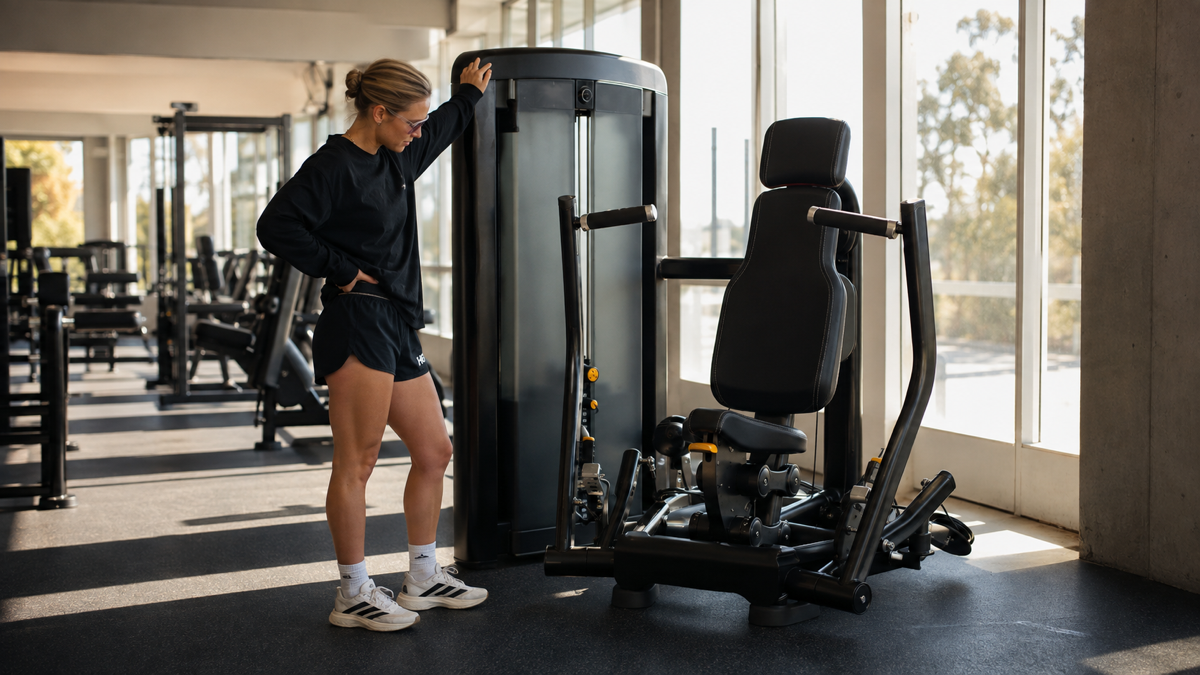
  • How to Use Gym Equipment: A Beginner’s Machine Guide

    How to Use Gym Equipment: A Beginner’s Machine Guide

    You sit down at a machine, find three yellow levers, and suddenly the tiny diagram on the side looks like an engineering exam. Meanwhile, someone nearby seems to adjust everything in four seconds.

    Nothing is wrong with you. Gym machines are easier once you know the same setup pattern works on most of them.

    Here is the short answer to how to use gym equipment: read the machine’s instruction placard, check that it looks intact, adjust the seat and pads to fit your body, choose a light resistance, and try a few slow reps. If the movement feels controlled and the machine fits, continue. If it pinches, pulls you out of position, or causes pain, stop and reset.

    This guide focuses on the strength machines and cable stations that often cause the most setup confusion. For cardio equipment, learn the stop controls before you increase the pace. With free weights, clear a stable space and choose a load you can pick up and set down with control.

    You do not need to learn the whole gym in one visit. Pick three or four machines, save their settings in your phone, and repeat them next time. That is enough to turn a room full of unfamiliar equipment into a short list you know.

    Use this six-step setup routine on almost any machine

    Learning how to use gym machines is less about memorizing every model and more about following a reliable order. Use these six steps before your first working set.

    1. Read the name and movement diagram

    Look for the instruction placard on the frame. It usually shows the machine name, the main muscles involved, the start and finish positions, and the available adjustments.

    Treat that placard as the instructions for the exact machine in front of you. Two chest press machines can have different levers, handle paths, and seat positions. A video of another model cannot tell you where every pin belongs on this one.

    If the label is missing or the movement is still unclear, ask a staff member to demonstrate the adjustments before you add weight. A quick setup demonstration is a normal thing to ask for.

    2. Check the machine before you sit down

    Take a quick look at the cable, handles, pads, and moving arms. Do not use the machine if a cable looks frayed, a pad or handle is loose, a guard is missing, or the machine is marked out of order. Tell the floor staff and choose another station.

    Keep your hands, hair, headphones, and loose clothing away from the weight stack and other moving parts. Leave enough room to get on and off without stepping into another person’s exercise space.

    3. Set the seat, back pad, and range

    Adjustment handles are often a bright color. Let the weight stack rest and return the moving arm to its start position. Then pull the adjustment pin or lever, move the seat or pad, and make sure it locks fully before you use the machine.

    Your goal is not to copy the number used by the previous person. You are trying to line up the machine with your body:

    • On a pressing machine, the handles should start around chest or shoulder level, depending on the exercise.
    • On a row, you should reach the handles without rounding your back or losing contact with the support pad.
    • On a leg curl or leg extension, the machine’s pivot should sit close to the side of your knee joint.
    • On a pulldown, the thigh pad should hold you in place without digging in.
    • On a leg press, choose a start position that lets your feet stay flat and your hips and back remain supported.

    If you cannot find a setting that fits, use a different version of the exercise. You do not have to fold yourself into a machine simply because it is available.

    4. Select a light resistance

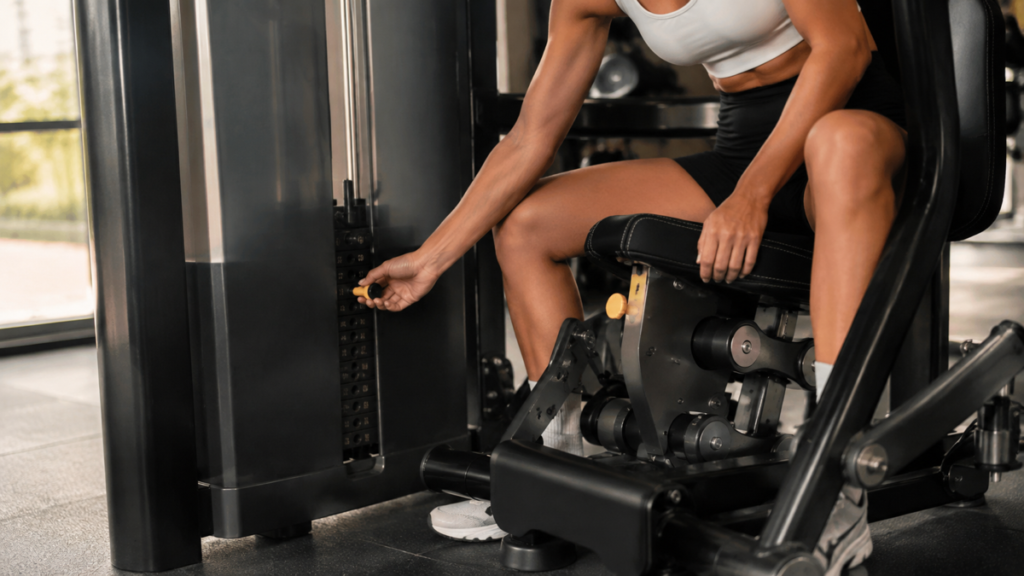
    On a selectorized machine, the pin chooses how many plates will lift. Insert it completely into one hole while the weight stack is resting. Do not leave it halfway in or move it while the plates are raised.

    On a plate-loaded machine, add plates to the loading pegs. Load both sides evenly unless the machine’s own instructions say otherwise, and use the required collars or stops. If you are not sure how the arms release from their supports, ask before loading the machine.

    Start lighter than you think you need. The number on one machine does not translate neatly to another, so it is not useful as a score.

    Beginner inserting the selector pin into the resting weight stack of a real chest press.

    5. Do a few test reps

    Sit or stand in the position shown on the placard. Brace your feet, keep your body against the intended supports, and move the handles or platform through a comfortable range.

    Use a smooth pace. Do not let the stack slam down between reps. During the test, notice three things:

    1. Can you keep the same body position from start to finish?
    2. Does the machine move smoothly without a joint feeling pinched or forced?
    3. Can you control both the lifting and returning parts of the rep?

    If the answer is no, stop and change one variable: the seat, the pad, the range, or the resistance. Testing is part of the setup, not a failed set.

    6. Record the settings that worked

    Write down the machine name, seat or back-pad number, resistance, and reps. Add a short note if the machine has an unusual handle or location.

    For example: Seated row near windows — seat 4, chest pad 3, 20 lb, 10 reps.

    Those details remove decisions from your next visit. They also help you notice progress without relying on memory.

    Know what type of gym equipment you are using

    You do not need to memorize every machine. Start with a few basic equipment types.

    Equipment typeHow you recognize itWhat to set firstBeginner watch-out
    Selectorized strength machineWeight stack with a removable pinSeat, pads, range, then weight pinMake sure every adjustment is locked and the selector pin is fully inserted
    Plate-loaded machineLarge pegs for round weight platesSeat and start position, then platesLoad and unload evenly; learn how the supports release before the set
    Cable stationAdjustable pulley with clips and attachmentsPulley height, attachment, then weight pinConfirm the clip is closed and stand clear of the weight stack and cable path
    Cardio machineConsole with speed, resistance, or incline controlsEasy start setting and stop controlsLearn the stop button before increasing speed or resistance
    Free weights and benchDumbbells, kettlebells, barbells, adjustable benchClear space and stable bench positionUse a load you can lift into and out of position without swinging or dropping it

    Selectorized machines often feel approachable because the path is guided and changing the load takes one pin. That does not make every machine a perfect fit, and it does not make free weights an advanced-only option. For general strength training, research reviewed by the American College of Sports Medicine did not find one equipment type consistently superior across the outcomes studied.

    Choose equipment you can access, adjust, and repeat with control. Familiar is useful. Fancy is optional.

    How to set up common gym machines for beginners

    The placard on the exact model always comes first. Use the cues below to understand what you are trying to line up, then adapt them to the machine in your gym.

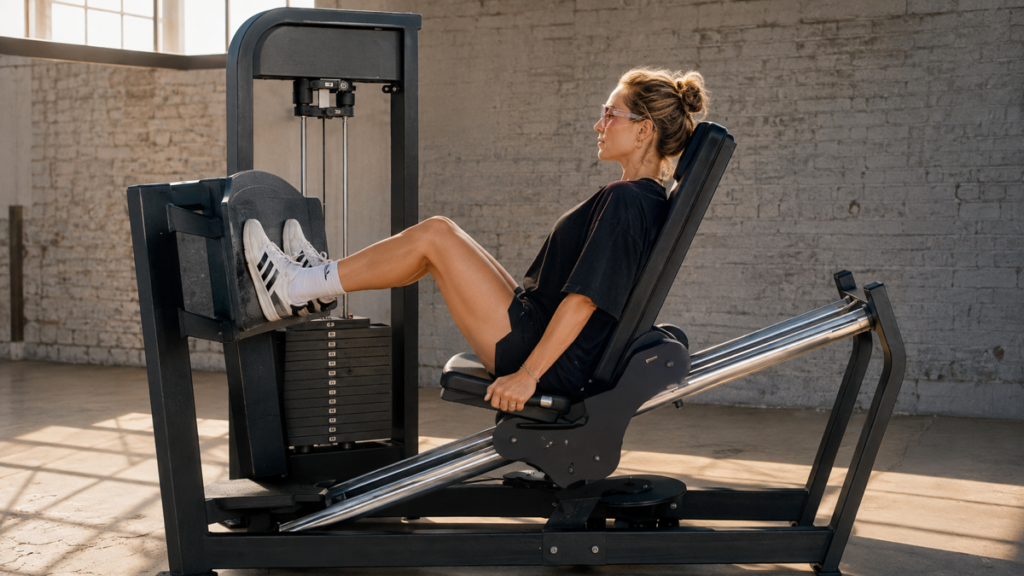
    Leg press

    Adjust the seat so your knees and hips begin in a comfortable bent position. Place both feet flat on the platform, around hip- to shoulder-width apart. Keep your hips and back against the pads as you press the platform away.

    Straighten your legs with control, but do not snap or force your knees into a locked position. Return only as far as you can while your feet stay flat and your pelvis remains supported.

    Woman using a selectorized seated leg press with a fixed footplate and moving seat carriage.

    Reset if: your heels lift, your hips curl off the pad, your knees hurt, or the starting position feels cramped.

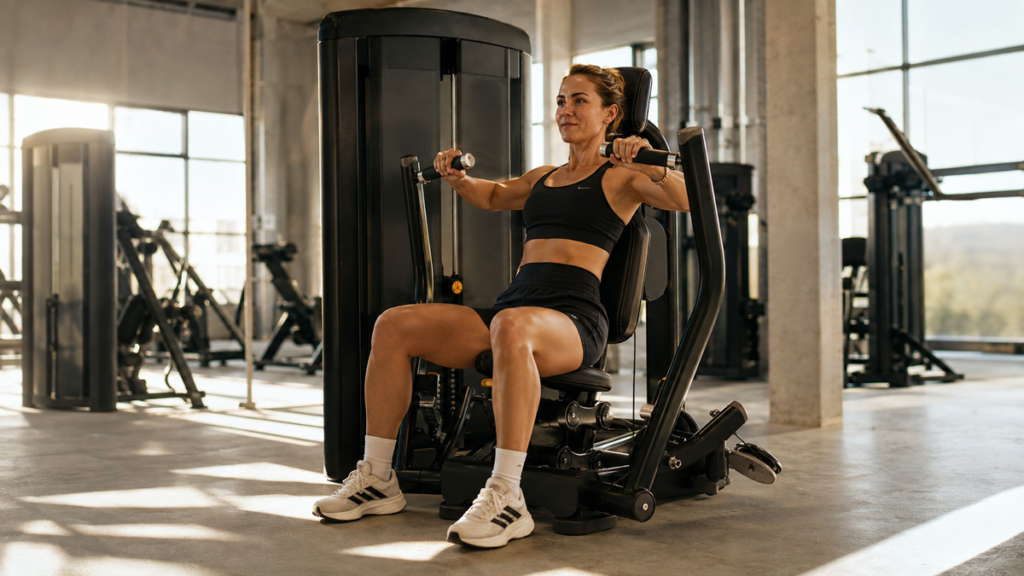
    Seated chest press

    Set the seat so the handles begin around mid-chest and your wrists can stay in line with your forearms. Keep your feet down and your back supported. Press forward smoothly, then return without letting the weight stack crash.

    Woman using a selectorized chest press with independent lower-mounted arms and supported posture.

    The handles do not need to travel as far back as possible. Use a range that lets your shoulders stay comfortable and supported.

    Reset if: the handles sit near your neck or stomach, your shoulders roll forward, or you have to arch away from the pad.

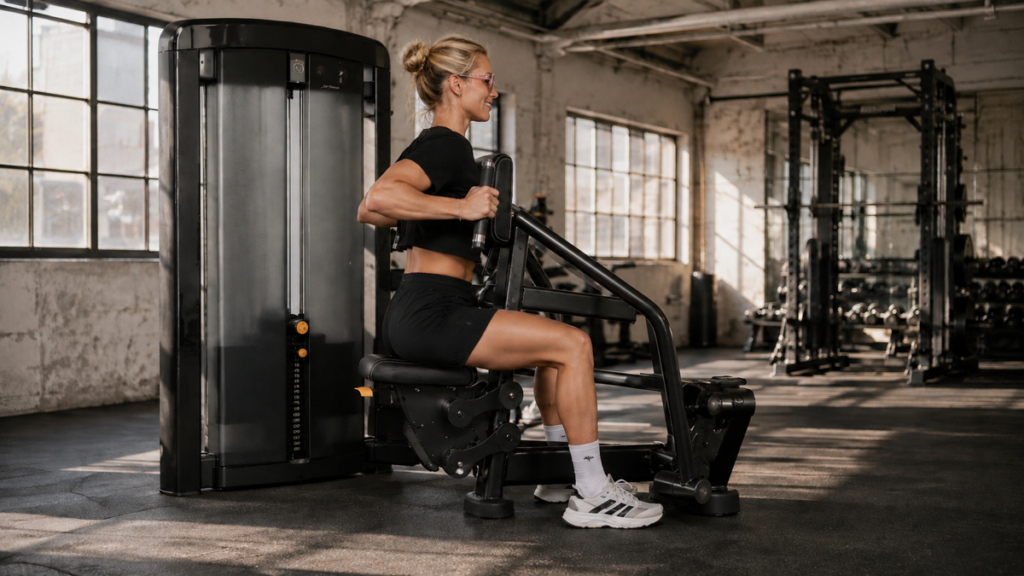
    Seated row

    Set the seat so the chest support meets your mid-chest. Adjust the chest pad, if possible, so you can reach the handles with long arms without rounding forward.

    Keep your torso supported and pull your elbows back through a range you can control. Return slowly until your arms are long again without letting the weight pull your shoulders or torso forward.

    Reset if: you cannot reach the handles without slumping, the chest pad limits your breathing, or your torso rocks with every rep.

    Lat pulldown

    Choose the resistance before you sit. Hold the handles or bar, sit down, and adjust the thigh pad so it keeps you stable without pressing painfully into your legs.

    Start with your arms overhead and keep your torso upright rather than leaning far back. Pull until your elbows come toward your sides and the handles reach about shoulder level, or follow the end position shown on your model. Return with control.

    Reset if: your body swings, you have to lean far back, the thigh pad does not hold you down, or you pull the bar behind your neck.

    Seated leg curl

    Adjust the back pad so the side of your knee lines up with the machine’s pivot. Place the lower pad behind your ankles and bring the thigh pad down until it feels secure, not crushing.

    Hold the handles, keep your hips down, and bend your knees to draw the ankle pad down and back. Let it return slowly.

    Reset if: the pivot sits well above or below your knee, the roller presses directly on your heel, or your hips lift to move the weight.

    Cable station

    Set the pulley height while the stack is resting. Clip on the correct attachment and make sure the carabiner closes. Select a light load, take hold of the attachment, and step into a stable position before you begin.

    Keep the cable running in a clear line. Do not put fingers near the pulley, stand under an attachment someone else is changing, or let go while the stack is raised. Walk the handle back to its start position when you finish.

    Ready to choose movements rather than decode equipment? This list of gym exercises for beginners explains the purpose and form of eight practical options.

    How to choose your starting weight

    Your first weight is a test, not a commitment. Pick a load that looks almost too easy and try a few controlled reps after you finish the setup.

    If the machine fits and those reps feel steady, continue for a few more controlled reps. End the set before your form changes. The last reps can feel challenging, but they should still look controlled.

    Woman testing a light weight on a chest-supported selectorized seated row with one working handle pair.

    Lower the resistance if you have to:

    • jerk the handles or bounce the platform;
    • hold your breath through the whole rep;
    • shorten the range suddenly;
    • lift away from the seat or support pad;
    • rush the return because you cannot control it.

    You do not need to reach complete muscle failure to make a set count. When all your planned reps look controlled for more than one session, increase the load by the smallest available step and test again. Change one thing at a time so you know what worked.

    Machine labels may use pounds or kilograms, and two stacks with the same printed number can feel different. Record the setting for that specific machine rather than comparing numbers across the gym.

    A simple way to practice on your first visit

    Do not turn your first equipment lesson into a tour of every machine in the building. Choose one station from each of these categories:

    • a lower-body push, such as a leg press;
    • an upper-body push, such as a chest press;
    • an upper-body pull, such as a seated row;
    • one optional second lower-body move, such as a seated leg curl.

    If easy walking or cycling helps you settle in, keep the pace comfortable. Then set up each machine, do a few test reps, and complete a short controlled set if the setup feels right. Rest until you can begin the next exercise without rushing.

    The goal of this visit is to learn a few setups, not cover the whole room. Four machines are enough for one useful practice session. If you want the exercises arranged into a repeatable session, follow this beginner gym workout with machines.

    Stop the exercise if you feel pain, dizziness, faintness, chest pressure, or unusual shortness of breath. If a movement simply feels awkward, lower the weight and reset the machine. If it still does not fit, skip it and choose another option.

    What to do when the gym is busy

    A full gym can make a simple plan feel surprisingly complicated. Keep the training goal, not one exact machine.

    • Your machine is occupied: move to the next exercise and return later, or ask, “How many sets do you have left?”
    • Someone is resting beside it: ask before changing the pin or seat. They may still be using it.
    • You cannot find the adjustment lever: check both sides and under the seat, then ask staff instead of forcing a part.
    • The machine is marked out of order: do not test it. Choose another exercise and let the staff know if needed.
    • Someone left plates on a machine: confirm that the station is free before unloading it. Remove plates in small, alternating steps so one side is not suddenly much heavier.
    • You only have 20 minutes: practice two or three machines well. Learning fewer settings is more useful than racing through six.

    You can also save one swap for each exercise in your notes. A chest press can become a wall or incline push-up. A seated row may become a light cable row. A machine being busy does not cancel the whole session.

    Common gym-equipment mistakes and quick fixes

    Copying the previous person’s settings

    Their seat number, range, and weight fit their body and session. Reset the machine from scratch, even if you are similar in height.

    Adding weight before checking the fit

    The wrong seat position becomes harder to notice once you are focused on moving a heavy stack. Adjust first, test light, then add resistance.

    Moving as far as the machine allows

    The mechanical limit is not your personal target. Use a comfortable range you can control without your feet, hips, back, or shoulders losing their intended support.

    Letting the stack slam

    A loud landing often means the return is too fast. Slow down before the plates touch. If you cannot, reduce the load.

    Changing several settings at once

    If the movement feels wrong, adjust one variable and retest. Start with the seat or back pad, then the range, then the weight. Otherwise, you will not know which change helped.

    Treating every machine number as comparable

    Pulley systems, lever arms, and machine designs change how a load feels. Compare your progress on the same model whenever possible.

    Make the next visit easier than the first

    Learning how to use workout machines does not require a perfect memory or a fearless first day. One familiar setup at a time is enough.

    Your next step is simple: return to the same three machines, use your notes, and change only one variable at a time. Those rows of levers and pins will start to look less like one giant puzzle and more like individual tools you know how to use.

  • Gym Exercises for Beginners: 8 Moves to Learn First

    Gym Exercises for Beginners: 8 Moves to Learn First

    You arrive at the gym with a water bottle, a saved playlist, and one unresolved detail: what are you actually supposed to do with all that equipment?

    You do not need to recognize every machine before you begin. If you want basic gym exercises for beginners, start with these eight: leg press, dumbbell Romanian deadlift, chest press, seated row, lat pulldown, machine shoulder press, step-up, and dead bug. Together, they cover your legs, hips, chest, back, shoulders, and trunk.

    You also do not need to perform all eight in one workout. Learn two or three at a time, use a light resistance, and stop each set while your movement is still controlled. The goal of your first visits is to build a small library of exercises you know how to set up and repeat.

    Eight beginner gym exercises at a glance

    The table gives you eight practical exercises to do in the gym for beginners, but the exact machines will vary. Read the instruction label on the model in front of you and ask a staff member to show you the adjustments if anything is unclear.

    ExerciseMain areas trainedBeginner starting pointEasy swap
    Leg pressThighs, glutes, hipsLight machine resistanceBodyweight squat to a bench
    Dumbbell Romanian deadliftHamstrings, glutes, back-body controlPractice the hip hinge without weightSeated leg curl
    Chest pressChest, shoulders, tricepsSeated machineWall or incline push-up
    Seated rowUpper back, shoulders, bicepsChest-supported machineLight cable row
    Lat pulldownBack, shoulders, armsNeutral or comfortable overhand gripResistance-band pulldown with a secure anchor
    Machine shoulder pressShoulders, tricepsBack-supported machineSkip it if overhead movement is uncomfortable
    Step-upThighs, glutes, balanceLow platform with nearby supportSupported split squat
    Dead bugTrunk controlMove one heel at a timeHeel slide

    An exercise earns a place on a beginner list when you can adjust it to your body, understand what is moving, and repeat it without rushing. “Easy” does not mean effortless. The best easy gym exercises for beginners are challenging enough to feel like work while leaving you in control of the next rep.

    Machines and free weights can both work. The 2026 American College of Sports Medicine position stand found that equipment type did not consistently change results for the average healthy adult. A machine may reduce the balance and setup demands of a movement. Dumbbells may offer more freedom to find a comfortable path. Choose the version you can perform well and access regularly.

    How to do the eight exercises

    For each new movement, begin with a no-weight or very light test. Try five slow reps, adjust the setup, and only then decide whether to add resistance. A machine number or dumbbell label is information, not a score.

    1. Leg press

    The leg press trains your thighs and glutes while the seat supports your torso. It is a practical place to learn a squat-like pushing pattern without balancing a weight.

    Sit with your back and hips against the pads. Place your feet about hip- to shoulder-width apart and keep your heels down. Bend your knees through a range that feels comfortable while your hips stay in contact with the seat. Press the platform away, stopping before you forcefully lock your knees, then return with control.

    Make it easier: reduce the weight or shorten the range. Reset the setup: if your heels lift, your hips curl away from the pad, or your knees hurt.

    2. Dumbbell Romanian deadlift

    This exercise teaches a hip hinge: your hips travel backward while your knees stay softly bent. It works the hamstrings and glutes and helps you practice moving at the hips without turning every lower-body exercise into a squat.

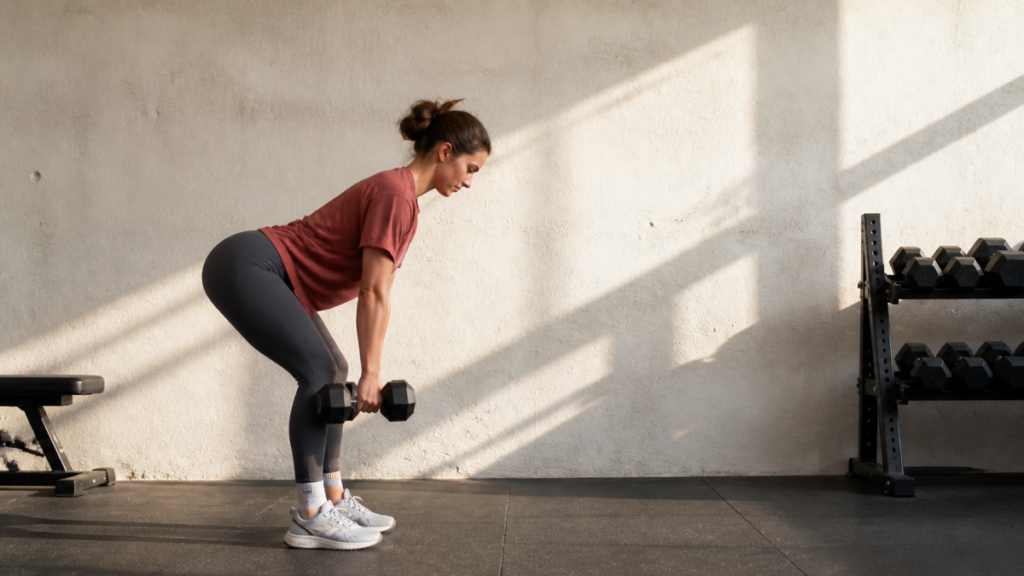
    Learn the pattern before picking up dumbbells. Stand a short step in front of a wall and send your hips back until they tap it. Keep your ribs stacked over your pelvis and your spine long. When that feels steady, hold two light dumbbells close to your thighs, push your hips back, and lower only until you feel tension in the back of your legs without losing your position. Press through your feet and bring your hips forward to stand.

    Beginner practicing a light dumbbell hip hinge with the weights close to her legs.

    Make it easier: keep practicing the wall hinge or use a seated leg-curl machine instead. Stop the set: if you feel sharp back pain, cannot keep the weights close, or have to jerk them upward.

    3. Seated chest press

    The chest press is a horizontal pushing exercise for your chest, shoulders, and triceps. The machine version gives you a stable base while you learn the path.

    Adjust the seat so the handles begin around mid-chest height. Keep your feet planted, back supported, and wrists in line with your forearms. Press the handles forward without shrugging or letting your shoulders roll away from the pad. Bend your elbows slowly to return through a comfortable range.

    Make it easier: lower the resistance or limit the deepest part of the return. Try another option: use a wall push-up if the machine cannot be adjusted to fit you.

    4. Seated row

    The seated row trains your upper back and arms. It also introduces a basic horizontal pull, the opposite direction of a chest press.

    Set the seat and chest pad so you can reach the handles with long arms without rounding forward. Sit tall, keep your wrists straight, and pull your elbows toward your sides. Pause when your hands reach your body, then straighten your arms slowly without letting the weight pull you out of position.

    Make it easier: choose a lighter stack setting and use chest support. Lower the weight: if you need to rock backward or snap the handles toward you.

    5. Lat pulldown

    The lat pulldown is a vertical pull for your back and arms. It can help you learn the same general pulling direction used in a pull-up while the weight stack remains adjustable.

    Secure the thigh pad so it holds you comfortably in the seat. Take a grip that does not pinch your shoulders or wrists. Keep your torso mostly upright and pull the bar or handles toward your upper chest by driving your elbows down. Let your arms lengthen again without dropping the stack.

    Make it easier: reduce the weight or use neutral-grip handles, with your palms facing each other, if available. Avoid: pulling the bar behind your neck or turning the movement into a large backward swing.

    6. Machine shoulder press

    The shoulder press is a vertical push for your shoulders and triceps. A back-supported machine can make the setup simpler than pressing free weights overhead.

    Adjust the seat so the handles start close to shoulder height. Keep your feet down, wrists straight, and back supported. Press upward through the range you can control, then lower slowly. Your ribs should not flare forward to create extra movement.

    Make it easier: lower the weight and press only through a range you control. Skip it for now: if reaching overhead is painful or the machine forces you into an uncomfortable position. Your session can still cover the major pushing pattern with the chest press.

    7. Step-up

    A step-up trains your legs and glutes one side at a time. It also asks for more balance than a leg press, so the height matters more than how impressive the box looks.

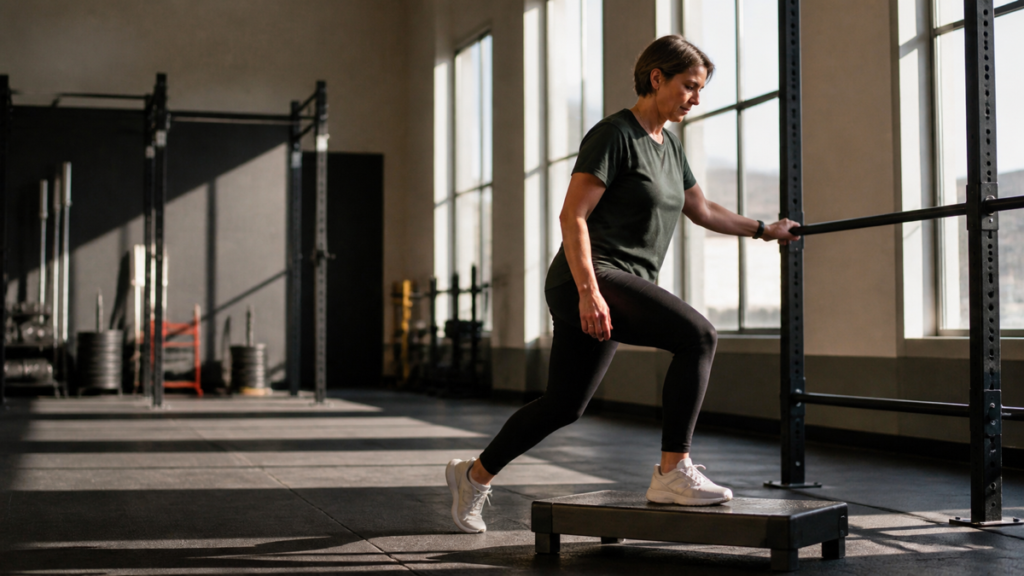
    Choose a low, stable platform. Place your whole foot on it, lean forward slightly, and press through that foot to stand. Step down with control. Keep a rail or sturdy support within reach, and complete your reps on one side before switching if that helps you stay organized.

    Beginner stepping onto a low platform with her whole foot planted and support nearby.

    Make it easier: use a lower step, hold support, or practice without added weight. Choose another move: if you cannot keep the working foot planted or step down smoothly.

    8. Dead bug

    The dead bug trains your trunk to stay steady while your arms and legs move. No cable stack is required; a mat and enough floor space will do.

    Lie on your back with your knees bent and feet down. Gently tighten your middle, then slide one heel away and bring it back without your lower back arching farther from the floor. Alternate sides. If that feels steady, lift your knees over your hips and lower one heel at a time.

    Make it easier: make the heel slide shorter. End the set: when your back position changes, your neck tenses, or you can no longer breathe comfortably.

    How to choose the right starting weight

    The right first weight is light enough to let you learn and heavy enough to give you useful feedback. You should not have to guess from the dumbbell rack and defend your choice for the rest of the workout.

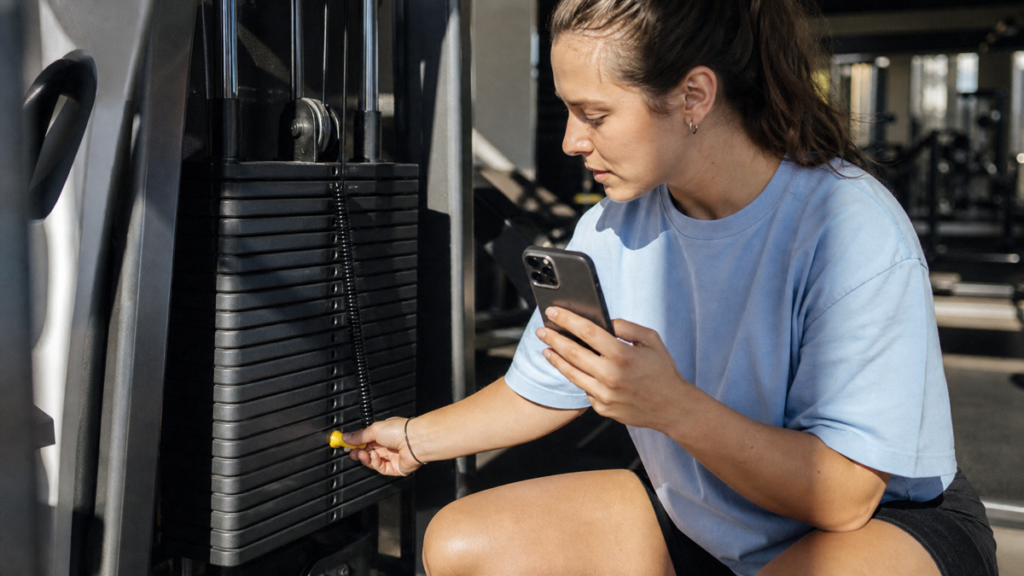
    Woman choosing a low resistance-machine setting and recording it on her phone.

    Use this quick check:

    1. Practice the path without weight or at the lightest useful machine setting.
    2. Perform five controlled test reps.
    3. Add the smallest available amount only if the movement still feels very easy.
    4. For your first work set, stop while you could still complete about two or three clean reps.
    5. Record the machine, seat setting, weight, and reps for next time.

    The last few reps can feel demanding, but your range and speed should remain recognizable. If you hold your breath, bounce the weight, twist, or shorten the movement without meaning to, reduce the load and try again.

    Training to the point where you cannot complete another rep is not a beginner requirement. Current ACSM guidance emphasizes that advanced methods and training to momentary failure are optional for the average healthy adult. A repeatable set is more useful than one dramatic set that makes the rest of the session fall apart.

    Stop an exercise if it causes pain rather than ordinary muscular effort. End the workout and get appropriate help if you feel faint or dizzy, develop chest pain or pressure, have an irregular or racing heartbeat, or become unusually short of breath. If you have an injury, ongoing pain, a chronic condition, or need pregnancy or postpartum modifications, get individualized guidance on exercise choice and load.

    How to turn the list into a simple first session

    Eight exercises are options, not an eight-part entrance exam. For a first practice session, choose five:

    1. One knee-dominant leg exercise: leg press or step-up.
    2. One hip or hamstring exercise: Romanian deadlift or leg curl.
    3. One push: chest press or shoulder press.
    4. One pull: seated row or lat pulldown.
    5. One final move: the second pull, dead bug, or another exercise you want to practice.

    Begin with five minutes of easy walking or cycling so your breathing and heart rate rise gradually. Complete one light set of 6–10 controlled reps per exercise, or 4–6 reps per side for the dead bug. Rest until you feel ready to repeat good form; you do not need to turn the strength section into a race.

    Want the machines, order, sets, and progression already chosen? Use this six-machine gym beginner workout for your first few visits.

    If the gym is packed, move to the next exercise instead of guarding one machine like it is the last seat on a train. Keep the same movement category when you swap: row for row, press for press, and lower-body exercise for lower-body exercise. When no equipment is free, these bodyweight exercises for beginners give you controlled alternatives.

    Over time, work toward training all major muscle groups on at least two days each week, as current U.S. physical activity guidance recommends. That target does not require a complicated split. Two short full-body sessions can be a practical starting structure.

    If you need to fit strength and cardio into a busy week, this guide to how to start working out gives you a realistic first schedule.

    Common mistakes when learning gym starter exercises

    • Trying every exercise in one visit. Learn a small set, record the settings, and add a new movement later.
    • Copying someone else’s machine position. Their seat number suits their body. Reset every machine before you use it.
    • Choosing weight before learning the path. A light test gives you better information than the number on the stack.
    • Treating discomfort as proof that it works. Muscles can feel challenged; joints should not feel sharp, pinched, or unstable.
    • Changing the exercise every week. Repeating a few movements helps you improve the setup and notice when the same weight feels more controlled.
    • Forcing the full range shown online. Use the largest comfortable range you can control on the equipment available to you.
    • Adding weight to fix a boring session. You can improve a rep by moving with more control before making it heavier.

    FAQ

    What are the best gym exercises for beginners?

    The best choices cover the main movement directions and are easy to adjust. A leg press, Romanian deadlift or leg curl, chest press, row, lat pulldown, and a simple trunk exercise create a useful base. The specific equipment matters less than controlled technique and regular practice.

    How many exercises should a beginner do at the gym?

    Four to six exercises are enough for a focused first strength session. Choose a lower-body movement, a push, a pull, and one or two supporting exercises. More movements are not automatically more effective if the extra decisions make your form rushed.

    Should beginners use machines or free weights?

    Either can work. Machines may feel simpler because they guide the path and support your body. Free weights allow more movement choices and can help you practice balance and control. You can also combine them, such as a machine press with a light dumbbell hip hinge.

    Do women need different beginner gym exercises?

    No separate list is required simply because you are a woman. Exercise choice should reflect your goals, current ability, comfort, health, and available equipment. Individual modifications matter more than a gender label on a workout.

    How often should a beginner repeat these exercises?

    Two nonconsecutive full-body strength days can be a practical start. Repeat the same core movements long enough to learn them, then change an exercise when the equipment does not fit, the movement is uncomfortable, or your goals call for a different option.

    Choose your first three exercises

    Save the leg press, chest press, and seated row before your next visit. Find each machine, ask for one setup check if you need it, and complete a light practice set. That is enough for Day 1.

    Once those three feel familiar, add one lower-body or pulling movement. Your list of gym starter exercises will grow because you practiced them, not because you memorized the entire gym floor from the doorway.

  • Gym Beginner Workout: Your First Full-Body Machine Plan

    Gym Beginner Workout: Your First Full-Body Machine Plan

    You walk onto the gym floor, see three rows of machines, and realize “do a workout” is not nearly specific enough. Which seat moves? Where does the pin go? Is that person still using the leg press?

    You are not bad at the gym. You are simply being asked to make too many new decisions at once.

    Here is your gym beginner workout: warm up for five minutes, complete one set of 8–12 controlled reps on six machines, rest as long as you need to repeat good form, and leave with the settings written down. The first session will usually take 30–40 minutes. Its job is to make your next visit easier, not to test how much discomfort you can tolerate.

    Before your first gym day

    This plan is for a generally healthy adult who is new to resistance training and wants a simple introduction to common weight-stack machines. It is not a rehabilitation plan or an individual prescription.

    Get personalized guidance before starting if you have an injury, ongoing pain, a chronic condition, significant symptoms, or need pregnancy or postpartum modifications. Stop the workout if you feel pain, faintness, dizziness, chest pressure, an irregular or racing heartbeat, or unusual shortness of breath. Seek urgent medical help for severe or sudden symptoms.

    For your first gym day, keep the preparation basic:

    • save this routine on your phone or write the six machines in your notes;
    • wear clothes you can move in and secure, comfortable shoes;
    • bring water plus any towel, locker token, or lock your gym requires;
    • ask whether a staff member can show you how to adjust the machines;
    • plan to record the seat setting, weight, and reps after each exercise.

    A gym orientation is useful even if you do not want personal training. Five minutes spent finding the adjustment levers can save an entire session of guessing.

    Your gym workout for first timers at a glance

    Start with five minutes of easy walking or cycling. You should feel warmer, but you should still be able to talk comfortably. Then do the machines in the order below.

    On your first visit, complete one work set per exercise. Rest for about 60–120 seconds, or longer if your breathing and muscles are not ready. There is no prize for rushing between machines.

    ExerciseMain focusFirst-visit targetOne setup check
    Leg pressThighs, glutes, hips1 × 8–12Feet stay flat and your knees bend comfortably
    Seated leg curlBack of thighs1 × 8–12The machine pivot sits close to your knee joint
    Seated chest pressChest, shoulders, triceps1 × 8–12Handles begin around mid-chest height
    Seated rowUpper back, shoulders, biceps1 × 8–12You can reach the handles without rounding forward
    Lat pulldownBack and arms1 × 8–12Thigh pad holds you down without pinching
    Machine shoulder pressShoulders and triceps1 × 8–12Handles start near shoulder height in a comfortable range

    This beginner gym workout with machines trains the main lower-body, pushing, and pulling patterns without asking you to learn a barbell lift on day one. It is a starting template, not the only valid routine. Machine names and designs vary, so use the instruction label on the exact model and ask gym staff when its setup differs from the cues below.

    If six machines feel like too much, do the leg press, leg curl, chest press, and seated row. Four controlled exercises are more useful than six rushed ones.

    How to choose your starting weight

    The number printed on the weight stack is not a grade. Different machines can feel completely different, even when the labels show the same weight.

    Use this quick test for each exercise:

    1. Set the pin at a light resistance and make sure it is fully inserted.
    2. Do five slow test reps through a comfortable range.
    3. If you could easily do many more, move the pin up by the smallest available step.
    4. Begin your work set and stop with about two or three good reps still possible.
    Beginner testing a light resistance on a seated chest press with her back supported.

    The final reps should require focus, but they should look similar to the first ones. Lower the weight if you have to jerk the handles, shorten the movement suddenly, hold your breath, or move your body away from the pad.

    You do not need to train until you cannot complete another rep. The 2026 American College of Sports Medicine position stand found that training to momentary muscle failure did not consistently improve outcomes for the average healthy adult.

    How to set up any gym machine without guessing

    Most selectorized machines use the same basic process: adjust your position, choose the resistance with a pin, and move the handles or pad through a guided path. The details still matter.

    Before every exercise:

    1. Read the machine label. Check the pictured setup, adjustment points, and direction of movement.
    2. Adjust before adding effort. Position the seat, back pad, chest pad, or thigh pad for your body. Never copy the previous person’s settings without checking them.
    3. Secure the pin. Keep your fingers away from the moving weight stack and confirm the selector pin is fully seated.
    4. Practice the path. Use a light resistance for a few reps. Move only through a range that feels controlled and free of pain.
    5. Keep the return controlled. Do not let the plates crash together. Keep breathing; many people find it natural to exhale during the effort and inhale as the weight returns.

    A machine guides the resistance, but it does not know your limb length, injury history, or comfortable range. If you cannot make the setup fit, choose another model or ask for help instead of folding yourself into it.

    How to do the six exercises

    1. Leg press

    Sit with your back and hips supported. Place your feet about hip-width apart on the platform. Bend your knees only as far as you can while keeping your feet flat and your hips steady, then press the platform away without snapping your knees straight.

    Make it easier: reduce the resistance or use a smaller comfortable range. Stop and reset: if your heels lift, your hips curl away from the pad, or your knees feel painful.

    2. Seated leg curl

    Adjust the seat so the machine’s pivot is close to the side of your knee. Place the lower pad above your heels or against the lower calves, depending on the model. Keep your hips and back supported as you bend your knees, then return slowly.

    Make it easier: lower the weight and shorten the range. Stop and reset: if the pad sits on your heel, the seat pin is loose, or you have to swing your torso.

    3. Seated chest press

    Adjust the seat so the handles start around mid-chest height. Keep your feet planted, wrists straight, and back supported. Press forward without shrugging your shoulders, then let the handles return with control.

    Make it easier: choose a lighter setting or stop before the deepest part of the return. Stop and reset: if you feel shoulder pain or cannot keep your wrists in line with your forearms.

    4. Seated row

    Set the seat or chest pad so you can reach the handles with long arms and a tall torso. Pull your elbows back toward your sides. Pause briefly, then straighten your arms without letting the weight pull your shoulders far forward.

    Make it easier: reduce the resistance and use the chest support if the machine has one. Stop and reset: if you have to lean back or jerk the handles to finish a rep.

    5. Lat pulldown

    Sit with the thigh pad snug above your legs. Hold the bar a little wider than shoulder width, or use the machine’s neutral-grip handles. Pull toward your upper chest while keeping your torso mostly upright, then return until your arms are long but controlled.

    Make it easier: lower the weight or use a neutral grip if available. Stop and reset: if you pull the bar behind your neck, swing backward, or feel pain in your shoulders or elbows.

    6. Machine shoulder press

    Adjust the seat so the handles start close to shoulder height. Keep your back supported and wrists stacked over your forearms. Press upward through a comfortable range, then lower without dropping the stack.

    Make it easier: use less resistance or a shorter range. Skip it today: if overhead movement is uncomfortable. The workout still counts without it.

    What to do when the gym is busy

    The machine you need will eventually be occupied. This is a scheduling problem, not a reason to abandon the session.

    • Move to the next exercise and come back later.
    • Use another machine with the same movement label, then adjust it from scratch.
    • Ask a staff member for the closest simple alternative.
    • Do one set instead of two when you are short on time.
    • If only 20 minutes are available, warm up and complete the leg press, chest press, seated row, and leg curl.

    The most useful easy gym workouts for beginners include an exit ramp. A shorter version planned in advance keeps a packed floor or late meeting from making the decision for you.

    How to repeat and progress this simple gym workout

    Repeat the routine on two nonconsecutive days each week, such as Tuesday and Friday. Current U.S. guidance recommends muscle-strengthening work for all major muscle groups on at least two days a week. Treat that as a direction to build toward, not a demand to perfect every muscle group in your first session.

    Use this progression for your first four visits:

    • Visit 1: one set per exercise; learn the room and record your settings.
    • Visit 2: repeat the same weights; add a second set to two exercises if you feel ready.
    • Visit 3: work toward two sets on the exercises that still feel controlled.
    • Visit 4: if you complete 12 clean reps in both sets and could do two or three more, add the smallest weight increase next time.
    Woman recording machine settings, weight, and repetitions on her phone after a gym set.

    Change one detail at a time. Adding weight, sets, reps, and extra workout days together makes it hard to tell what your body is responding to.

    If soreness or fatigue interferes with normal daily tasks, keep the next visit lighter or repeat the previous one. If you miss a week, return to the last settings that felt manageable. You do not need a punishment workout to restart.

    Common first-timer mistakes

    • Using someone else’s seat settings. Your setup should match your body, not the person who trained before you.
    • Starting with a weight you hope is right. A light test set gives you better information than a guess.
    • Racing the weight back down. Control both directions and keep the plates from slamming.
    • Forcing a textbook range. Use the largest pain-free range you can control; a machine diagram cannot assess your joints.
    • Changing the routine every visit. Repeating the same small group of movements lets you learn the setup and notice progress.
    • Staying until you are exhausted. Your first workout has done its job when you have practiced the plan and know what to repeat.

    FAQ

    What should a beginner do at the gym?

    Begin with a short warm-up and a repeatable full-body strength routine. One set of six machine exercises is enough for a useful first visit. Learn the setup, keep two or three reps in reserve, and record what you did.

    How long should a beginner’s first gym workout be?

    About 30–40 minutes is practical for this plan: five minutes to warm up, roughly 20–30 minutes for the machines, and a few minutes to slow down and make notes. If you need longer to adjust equipment or ask questions, that is part of the workout too.

    How many days a week should a beginner go to the gym?

    Two nonconsecutive strength days are a simple starting point and align with current guidance for muscle-strengthening activity. You can walk, cycle, or do other aerobic activity on different days, but your first week does not need a complicated split.
    If you want to place those sessions inside a broader week, this guide to how to start working out combines short strength and cardio sessions into a realistic weekly plan.

    Are machines or free weights better for beginners?

    Neither is automatically better. Machines can reduce the balance and setup demands of some exercises, which may make the first sessions easier to follow. Free weights offer more movement options. Since equipment type does not significantly impact results for the average healthy adult, pick whichever option allows for good control and regular execution.

    What if I cannot finish every machine?

    Stop when you need to. Complete the four-machine short version or end the session after the exercise you are on. Missing one movement will not erase the work you did, and you can try the full list next time.

    Your next step

    Save the six-machine list before you leave home. At the gym, ask for help with the first seat adjustment, start lighter than your ego suggests, and write down each setting as you go.

    Your win for the day is simple: you leave knowing exactly what to repeat. That is how a room full of unfamiliar equipment starts to feel like a routine.

  • How to Start Working Out: A Realistic Beginner Plan

    How to Start Working Out: A Realistic Beginner Plan

    You decide you will start on Monday. Then Monday arrives, along with a full calendar, five saved workout videos, and no clue which one is actually meant for a beginner.

    You do not need more discipline before you begin. You need a smaller first step.

    Here is the short answer to how to start working out: choose one simple cardio activity and one full-body strength session, schedule two or three 10–20-minute blocks for your first week, and finish each session with some energy left. Repeat before you add more. Your first week is practice, not a fitness test.

    First, choose the right starting lane

    Most generally healthy adults can begin with light or moderate activity and build up. A walk, an easy bike ride, or a basic strength session is a more useful starting point than an all-out challenge.

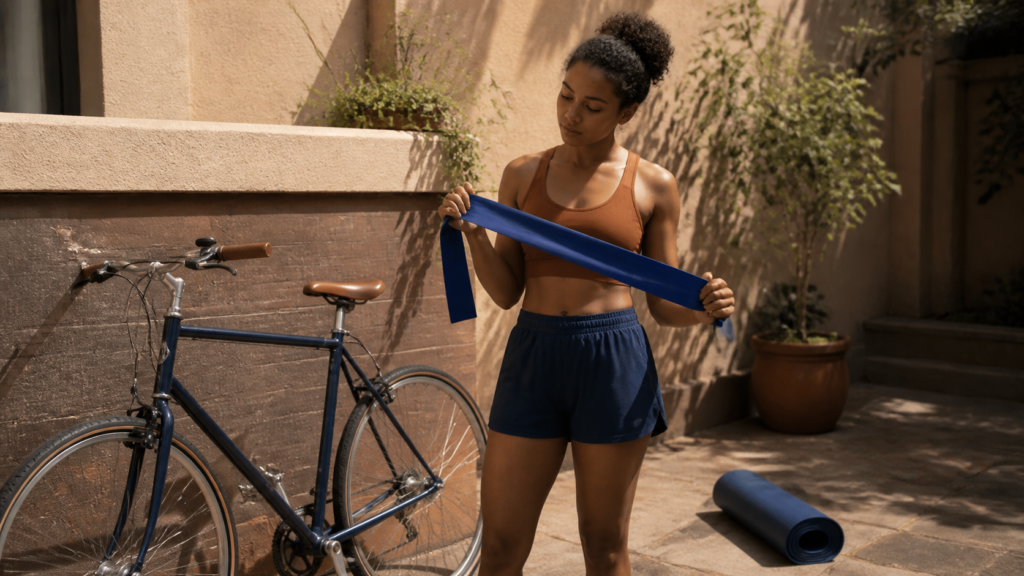
    Woman holding a resistance band beside a bicycle and exercise mat in a sunny courtyard.

    Get individualized advice before you begin if you have an injury, ongoing pain, a chronic health condition, significant symptoms, or need pregnancy or postpartum modifications. The same applies if you are returning after surgery or a serious illness. A qualified health or exercise professional can help you choose an appropriate type and amount of activity.

    During a workout, stop if you feel pain, dizziness, faintness, chest pressure, or unusual shortness of breath. Do not try to earn your way through a warning sign.

    How to start working out for beginners in seven steps

    1. Pick one reason that matters this month

    “Get fit” is too vague to guide Tuesday’s workout. Choose a reason you can connect to an action, such as:

    • feel less winded on stairs;
    • learn basic strength exercises;
    • move more during a desk-heavy week;
    • rebuild a routine after time away.

    Then choose one thing to track. It could be workouts completed, minutes walked, or the exercise version you used. Body weight, calories burned, and mirror checks are not required to prove that you started.

    2. Choose one cardio option and one strength option

    If you are learning how to start exercising for beginners, skip the hunt for a perfect workout style. Start with two basic categories:

    • Aerobic activity: brisk walking, cycling, swimming, or dancing—anything that raises your breathing and heart rate.
    • Strength activity: bodyweight exercises, resistance bands, machines, dumbbells, or another routine that works your major muscle groups.

    The current U.S. guideline for adults is 150 minutes of moderate aerobic activity a week, or 75 minutes of vigorous activity, plus muscle-strengthening activity on at least two days. That is a direction to build toward, not a Week 1 entrance fee. Any amount of activity can offer benefits, and short bouts count.

    Choose options that match your current ability, schedule, space, and budget. A home session is not a lesser workout. The 2026 American College of Sports Medicine review found that bodyweight, resistance-band, and home-based strength training can be effective.

    3. Use this first-week plan if you are starting from scratch

    The best first schedule is one you can see yourself repeating during a normal week—not only during a rare, perfectly organized one.

    DaySessionWhat to do
    Monday10-minute cardioWalk, pedal, or dance at an easy-to-moderate pace.
    Wednesday15-minute strengthWarm up, then practice one controlled set of 4–6 beginner exercises.
    Saturday10–20 minutesRepeat the session you preferred, or take an easy walk.

    For the strength day, use these bodyweight exercises for beginners to choose controlled movements and easier variations.

    Move the days as needed. Keep some space between strength sessions if you repeat them. If three sessions are unrealistic, do two. If 10 minutes is too much today, start with five.

    This is how to start working out from scratch without turning your whole week upside down. Put the sessions on your calendar with a time and place: “10-minute walk after lunch” is much easier to act on than “exercise more.”

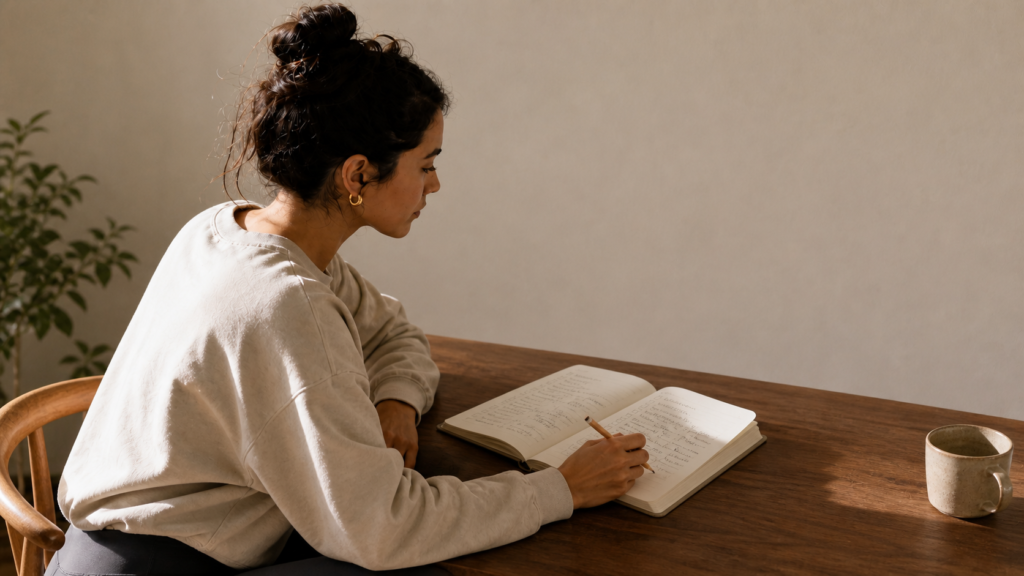
    Woman marking a small handwritten checkbox in an open daily planner at a sunlit wooden table.

    4. Keep the effort easier than your maximum

    For cardio, use the talk test. At a moderate effort, you breathe harder but can still hold a conversation. If you can only say a few words before taking a breath, the effort is vigorous. A true beginner can stay at an easy or moderate pace while learning what different effort levels feel like.

    For strength work, choose a version you can control. End the set before your form falls apart. Training to momentary muscle failure is not required for the average healthy adult to make progress.

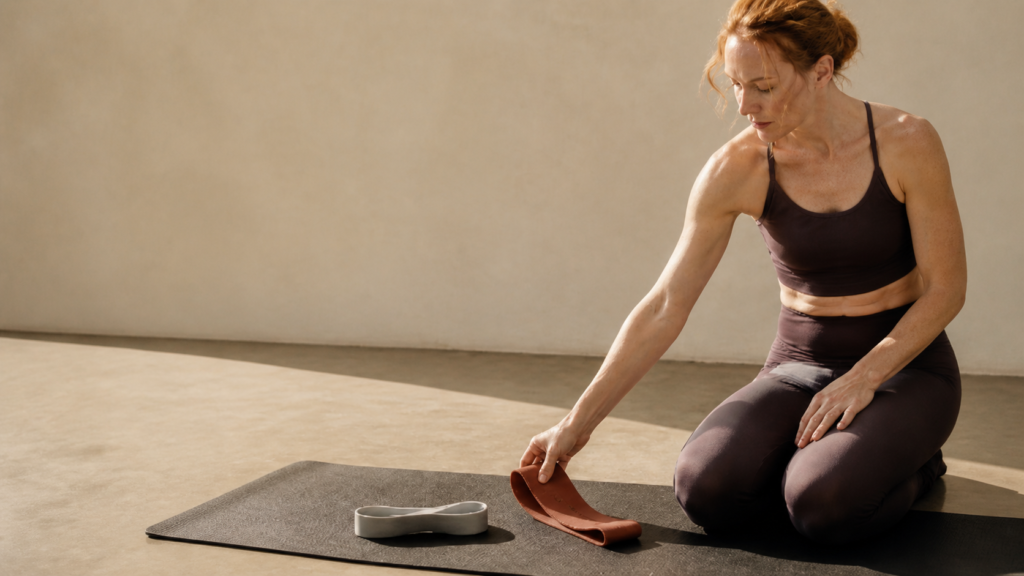
    Red-haired woman reaching for a terracotta resistance band beside a light dumbbell on an exercise mat.

    Begin each session with a few minutes of easier movement. Walk slowly before you pick up the pace, or rehearse the strength exercises with a comfortable range. Ease down at the end instead of stopping abruptly after hard effort.

    5. Progress one detail at a time

    When people ask how to slowly start working out, the useful word is “slowly.” Repeat your starting schedule for one or two weeks. If you recover well and the sessions feel controlled, change one thing:

    • add five minutes to one cardio session;
    • add a few controlled reps to an exercise;
    • add one set to part of your strength session;
    • add one short workout day;
    • choose a slightly harder exercise variation.

    Do not increase time, frequency, weight, and intensity in the same week. One change gives your body time to adapt and helps you notice what works.

    If fatigue, soreness, or discomfort makes daily life harder, reduce the next session or repeat the previous week. Progress does not require you to win every workout.

    6. Make the routine easy to begin

    Motivation is unreliable after a long day. Set up a cue that does some of the work for you:

    • keep your shoes near the door;
    • save one beginner routine instead of browsing every time;
    • block the session on your calendar;
    • pair a walk with your lunch break or commute;
    • keep a resistance band where you can see it.
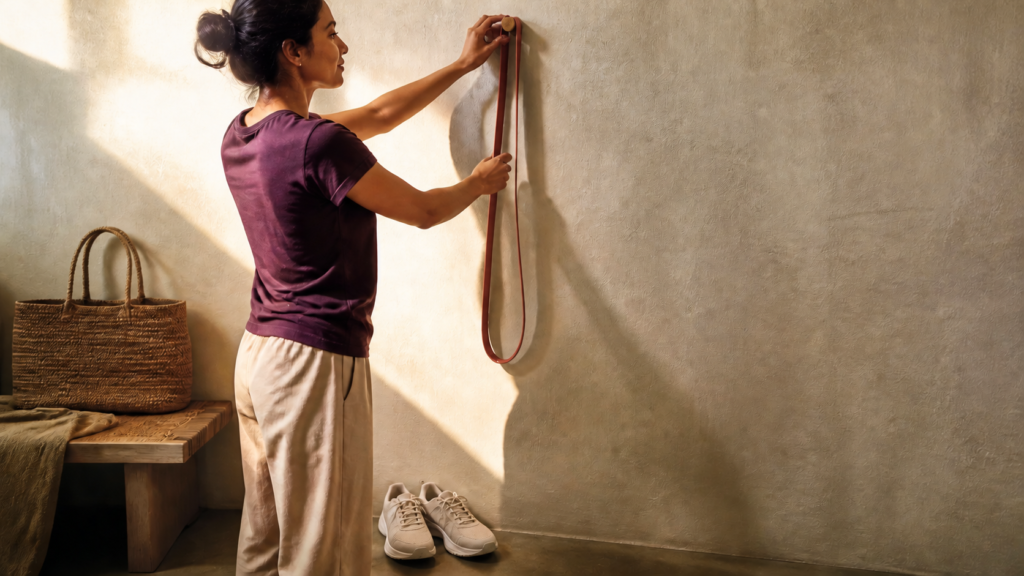
    Woman hanging a terracotta resistance band above a ready pair of training shoes.

    Also create a minimum version. Your 20-minute workout might become five minutes of walking on a packed day. That is a deliberate adjustment, not a loophole.

    7. Track the habit without demanding a perfect streak

    To learn how to start exercising regularly, record the smallest facts: date, activity, minutes, and one quick note about effort. You need enough information to plan the next session, not a dashboard that becomes another chore.

    If you miss a workout, do not double the next one. Return at the next practical time. If you miss a week, use the last version that felt manageable. Consistency is the act of returning, not the absence of interruptions.

    How to start exercising if you never have

    Starting from zero can feel awkward because every part is new: the movements, the effort, and even where to put your phone. Reduce the number of new decisions.

    • Choose a low-skill activity such as walking, a stationary bike, or a beginner machine circuit.
    • Learn four to six strength movements instead of collecting dozens.
    • Watch instructions before the session, then keep the routine visible while you practice.
    • Use a wall, bench, or stable support when balance is uncertain.
    • Stop while your technique is still controlled.

    You do not need special clothes, a gym membership, or an intense sweat session to qualify as someone who works out. You need one activity you can do safely and one time when you will do it.

    How to start working out again after a break

    Your old workout is not automatically your new starting point. After weeks or months away, begin with less time, less resistance, fewer sets, or an easier exercise version than you used before.

    For the first one or two weeks, focus on relearning the movements and seeing how you recover. Add difficulty only when the current session feels steady. If the break followed an injury, surgery, pregnancy, significant symptoms, or illness, ask a qualified professional for return-to-exercise guidance.

    This approach may feel conservative when you remember what you used to do. It is still faster than pushing too hard, feeling awful, and disappearing for another month.

    Common beginner mistakes that make starting harder

    • Copying an advanced schedule. A six-day split is not a badge of seriousness. It is simply more than most beginners need.
    • Using soreness as a score. A useful workout can feel challenging without making stairs miserable for three days.
    • Changing the plan every session. Repetition helps you learn technique and notice progress.
    • Making every session hard. Easier work gives you room to practice and recover.
    • Waiting for a free hour. A short session can establish the routine and add meaningful activity.
    • Treating a missed day as failure. Move the session or continue with the next one. You do not need to “make up” the missed work.

    FAQ

    How should a beginner start working out?

    Start with two or three short sessions that combine an accessible cardio activity with basic strength work. Keep the effort controlled, repeat the plan, and add only one small challenge at a time.

    How many days a week should a beginner work out?

    Two or three short days can be a practical first week, but there is no universal starting number. Your schedule, current activity, health, and recovery matter. Over time, work toward a weekly mix of aerobic activity and strength work on at least two days.

    How long should a beginner’s first workout be?

    Ten to 20 minutes is a useful trial for many beginners, not a minimum you have to meet. Five minutes is a valid start if you have been inactive, feel unsure, or have a very busy day. Finish at a point that makes a second session realistic.

    Can a beginner start working out at home?

    Yes. Walking, bodyweight exercises, and resistance-band routines can all be done at home. A gym adds equipment and support, but it is not required for your first workout or for effective strength training.

    Your next step

    Open your calendar and choose three possible 10–20-minute blocks. Label one “cardio,” one “strength,” and one “repeat or walk.” Then decide exactly where each session will happen.

    You do not have to feel like a workout person before you begin. Do the first small session, write down what you did, and let that evidence replace the guesswork.

  • Bodyweight Exercises for Beginners: 6 Moves With Form Tips

    Bodyweight Exercises for Beginners: 6 Moves With Form Tips

    You open a “beginner” workout, and the first move is a burpee. Suddenly, closing the video feels like the most sensible exercise on the list.

    You are not the problem. Beginner-friendly movement should give you room to learn. Start with these six simple bodyweight exercises for beginners: a squat, wall push-up, supported split squat, glute bridge, bird dog, and prone W raise. Together, they train your legs, upper body, and trunk without gym equipment, and every move has an easier option.

    This article helps you choose the right versions and practice them with clear safety checks. It is not a weekly training program. If you want a schedule, you will find a four-week plan after the sample round.

    Six exercises for beginners without equipment

    Bodyweight training uses your own body as resistance. “No equipment” does not have to mean no support: a wall or a sturdy chair can make an exercise more manageable while you build control.

    ExerciseMain focusStart withEasier optionProgress when ready
    Squat to a chairThighs, hips, glutes5–10 repsUse a higher chair or a smaller rangeHover above the chair
    Wall push-upChest, shoulders, arms5–10 repsStand closer to the wallStep farther back or use a stable counter
    Supported split squatLegs, glutes, balance5–8 per sideUse a shallower range and a wallUse less hand support
    Glute bridgeGlutes, back of thighs6–12 repsUse a smaller rangePause at the top
    Bird dogTrunk control, shoulders, hips5–8 per sideMove one limb at a timeReach the opposite arm and leg together
    Prone W raiseUpper back, shoulders6–10 repsKeep hands on the floorLift hands slightly with a relaxed neck

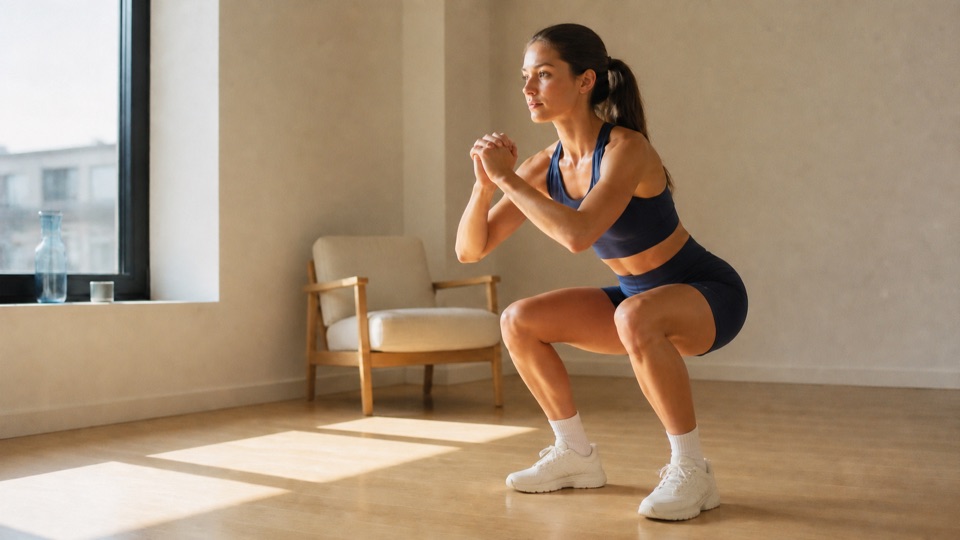
    1. Squat to a chair

    Stand in front of a stable chair. Bend your knees and send your hips back until you lightly touch the seat, then press through your feet to stand. Keep your full foot down. Use a higher seat or a smaller range if needed; hover above the chair when you are ready for more challenge.

    Common mistake: dropping quickly into the chair. Try instead: lower slowly enough to stay balanced and let the seat be a light target, not a place to collapse.

    2. Wall push-up

    Place your hands on a wall around chest height, a little wider than your shoulders. Step back, keep your body in one long line, and bend your elbows as your chest moves toward the wall. Push away. Stand closer to make it easier; step farther back or use a stable counter for more challenge.

    Woman performing a controlled wall push-up with both hands on a wall.

    Common mistake: letting the hips sag or the head reach the wall first. Try instead: keep your ribs, hips, and head moving as one line.

    3. Supported split squat

    Stand beside a wall with one foot forward and one back, as if they were on two train tracks. Use one hand for balance. Bend both knees through a comfortable range, then stand. Make the movement shallower if you wobble or feel strained.

    Woman using a wall lightly for balance during a supported split squat at home.

    Common mistake: standing with feet on one narrow line. Try instead: give your feet a little side-to-side space for balance.

    4. Glute bridge

    Lie on your back with your knees bent and feet down. Gently brace your middle, press through your feet, and lift your hips without arching your lower back. Lower slowly. Use a smaller range or skip the move if the floor position is uncomfortable.

    Woman performing a glute bridge with both feet grounded on an exercise mat.

    Common mistake: forcing the hips high by arching the back. Try instead: stop when your torso feels long and steady.

    5. Bird dog

    Start on your hands and knees. Reach one leg behind you without turning your hips, then switch sides. If that feels steady, reach the opposite arm forward too. Think “long,” not “high,” and shorten the reach if your torso twists.

    Woman holding a level bird dog position with opposite arm and leg extended.

    Common mistake: lifting the leg high. Try instead: keep your hips level and reach away from your body.

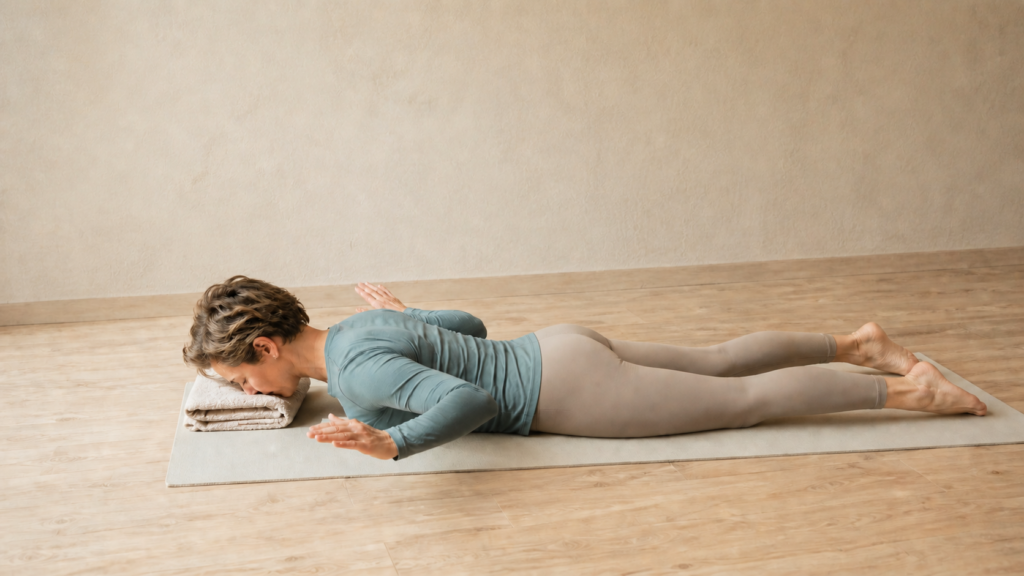
    6. Prone W raise

    Lie face down with your elbows bent in a W and your forehead supported. Gently draw your shoulder blades down, lift your hands a short distance, then lower. Keep your neck relaxed. If this position does not suit you, place your forearms on a wall and slide them up without shrugging.

    Woman practicing a prone W raise with a relaxed neck and small hand lift.

    Common mistake: tightening the neck. Try instead: use a smaller lift or choose wall slides.

    Which exercises count as compound movements?

    Compound exercises use several joints and muscle groups together. The squat, wall push-up, and split squat are clear compound bodyweight exercises for beginners. The bird dog also coordinates several areas, but its main role here is trunk control.

    Smaller movements still have a place. Six controlled exercises for your legs, upper body, and trunk are more useful than a long list you dread starting.

    A true pulling exercise is hard to create with zero equipment. The prone W raise works on upper-back control, but it does not replace a loaded row. A resistance band and secure anchor can add that missing pattern later.

    Try this simple full-body workout

    For a short full-body workout for beginners with no equipment, choose these six moves:

    1. Squat to a chair: 5–10 reps
    2. Wall push-up: 5–10 reps
    3. Supported split squat: 5–8 reps per side
    4. Glute bridge: 6–12 reps
    5. Bird dog: 5–8 reps per side
    6. Prone W raise: 6–10 reps

    March in place and practice a few easy reps first. Complete one set of each exercise, resting for 30–90 seconds or longer if needed. The session may take 10–20 minutes.

    Try it on two days of the week with recovery time between sessions. Current U.S. guidance recommends training all major muscle groups on at least two days each week. Build toward that target gradually.

    If six moves feel like too much, choose the squat, wall push-up, glute bridge, and bird dog. One calm round still counts as practice.

    Ready for a schedule? Follow the Bodyweight Exercise Program for Beginners.

    How to tell when an exercise is the right level

    The right version lets you:

    • move through a comfortable range without pain;
    • keep a steady pace instead of dropping or bouncing;
    • breathe rather than hold your breath through every rep;
    • finish knowing you could have done a few more controlled reps;
    • stay in control on both sides.

    When the top of the range feels steady in two sessions, add one or two reps, use a larger range, slow the lowering phase, or try a harder variation. Change one thing at a time.

    The 2026 American College of Sports Medicine position stand found that bodyweight and home-based resistance training can improve strength and physical function. It also found that training to momentary muscle failure is not consistently necessary for the average healthy adult. Consistent practice matters more than making every set dramatic.

    FAQ

    Can beginners build strength with bodyweight exercises?

    Yes. Bodyweight exercise is resistance training and can improve strength and physical function. It still needs to challenge you, so add reps, range, control, or a harder variation over time.

    Are easy bodyweight exercises for beginners too basic to work?

    “Easy” should mean appropriate for your current level, not effortless. A wall push-up may challenge one person and warm up another. Choose the version that becomes demanding while your form remains controlled.

    Can I do bodyweight exercises every day?

    You do not need to repeat the same challenging session daily. Recovery needs vary with exercise choice, effort, sleep, health, and training history. For a structured weekly schedule, use the four-week plan linked above.

    Your next move

    Choose one exercise that matches your current situation and practice three to five slow reps. Check what you feel, correct one mistake, and stop while the movement is still controlled. Once the technique makes sense, use the linked four-week plan to turn the exercises into a schedule.

  • Bodyweight Exercise Program for Beginners: A Simple 4-Week Plan

    Bodyweight Exercise Program for Beginners: A Simple 4-Week Plan

    You have 20 minutes, a patch of floor, and no desire to turn your living room into a mini gym. Good. That is enough to begin.

    This bodyweight exercise program for beginners uses six simple movements, two full-body sessions a week, and a four-week progression. Start with one round. Build to two. Choose the easiest version that lets you move with control. You do not need to finish shaky, breathless, or sore for the workout to count.

    Is This Program Right for You?

    This plan may suit you if you are new to strength training, returning after a break, or looking for a simple routine you can do at home without fitness equipment. It works best if you can set aside 15–25 minutes twice a week and want to learn the basics before adding more challenge.

    This plan is not designed for advanced strength or muscle-building goals, sport-specific training, or rehabilitation. If you have an injury, ongoing pain, a chronic condition, significant symptoms, or need pregnancy or postpartum modifications, get individual guidance from a qualified health professional before starting. A no-equipment plan also cannot fully replace loaded pulling exercises such as rows.

    How the Program Works

    Do the workout on two nonconsecutive days, such as Monday and Thursday. Each session takes about 15–25 minutes. Wear shoes or train barefoot only if the surface feels secure, and keep water nearby.

    Before each session, warm up for 3–5 minutes. March in place, roll your shoulders, practice a few shallow squats, and move your hips and ankles through a comfortable range.

    In this bodyweight exercise routine for beginners, complete the six exercises in order. Rest for 30–60 seconds between exercises and 60–90 seconds between rounds. Longer rest is fine if it helps you keep good form.

    ExerciseRepsMake it easierNext step
    Bodyweight squat6–12Use a smaller range or lightly hold a wallPause near the bottom
    Wall push-up6–12Stand closer to the wallMove to a stable counter, then the floor
    Supported split squat5–10 reps per sideUse a shallow range and hold a wallUse less hand support
    Glute bridge8–15Shorten the rangePause for two seconds at the top
    Bird dog5–10 reps per sideMove one limb at a timeReach the opposite arm and leg together
    Prone W raise6–12Keep your hands on the floorLift your hands slightly while keeping your neck relaxed
    Woman extending the opposite arm and leg during a bird dog exercise on a mat at home.

    This workout routine for beginners without equipment covers a squat, push, single-leg pattern, hip extension, core control, and upper-back movement. One honest limitation: without a band, bar, or weight, it is hard to train a true pulling pattern. The prone W raise is useful practice, but it is not the same as a loaded row. If you continue beyond this first month, a resistance band can fill that gap.

    See step-by-step instructions for all six exercises.

    The 4-week beginner bodyweight workout program

    This beginner bodyweight workout program adds work gradually. It is a template, not a deadline. Repeat a week if the next step feels too large.

    WeekFrequencyRoundsWhat changes
    Learn2 days1Use the lowest end of each rep range and learn the movements.
    Add a round2 days2Keep the same exercise versions and take the full rest you need.
    Add reps2 days2Add 1–2 reps only where your current reps feel controlled.
    Progress2-3 days2Add reps or choose a harder version for one or two exercises—not both.

    At every stage, finish each set when you feel you could still do about 2–3 controlled reps. If your form changes or the next week feels like too much, return to the previous version or repeat the week.

    The current U.S. physical activity guidance recommends muscle-strengthening activity on at least two days each week. This plan covers that part of the guidance. Adults are also advised to work toward 150 minutes of moderate aerobic activity each week, but you do not have to jump from zero to the full amount. Walking and other short bouts can be added gradually.

    What results can you expect after four weeks?

    Four weeks is a practice phase, not a transformation deadline. By the end of the plan, you may be able to:

    • perform the six movements with more familiar, controlled technique;
    • build the habit of completing two short strength sessions most weeks;
    • increase your training volume from one round to two and gradually add reps;
    • feel more confident choosing an easier or harder exercise version.

    Visible changes are not guaranteed, and results vary. The most useful outcome is knowing how to complete and adjust a basic workout without guessing what to do next.

    How to progress after Week 4

    A useful bodyweight workout plan for beginners changes only when the current version stops feeling challenging. You have several options:

    1. Add 1–2 reps within the listed range.
    2. Add a brief pause at the hardest point.
    3. Use a slightly harder exercise variation.
    4. Add a third round if you have the time and recover well.
    5. Add a resistance band to train pulling movements.

    Change one thing at a time. You do not need to rush toward jump squats, burpees, or training to failure. Current resistance-training evidence supports progressive practice and consistency; reaching momentary muscular failure is not required for the average healthy adult to make progress.

    Track the exercise version, reps, and rounds after each workout. If you can reach the top of the rep range with steady form in two sessions, try one small progression next time.

    Common beginner mistakes

    • Starting with the hardest version. The right variation is the one you can control today.
    • Racing through the reps. Slow down enough to notice your balance and joint position.
    • Turning every session into cardio. Rest supports better repetitions; it is not wasted time.
    • Adding everything at once. More reps, rounds, speed, and harder variations together make it difficult to judge what your body tolerates.
    • Doubling up after a missed day. Resume at the next practical time. One busy week does not erase the work you have done.

    FAQ

    Can beginners build strength with bodyweight exercises?

    Yes. Bodyweight training can help beginners build strength, especially when you are new to exercise. The key is to make the movements gradually more challenging over time—by adding reps, improving control and range of motion, or progressing to a harder variation when the current one feels comfortable.

    How many days a week should a beginner train?

    Two nonconsecutive full-body sessions are a practical start and align with the recommendation to train major muscle groups at least twice a week. More is not automatically better. Add a third day only if you feel recovered and can keep the same movement quality.

    What if I cannot do a floor push-up?

    Start at the wall. Move to a stable counter when 12 controlled wall push-ups feel manageable. A floor push-up is a later option, not an entry requirement.

    Woman performing an incline push-up against a stable kitchen counter.

    Your next step

    Put two 20-minute sessions on your calendar and do Week 1 exactly as written. This bodyweight exercise program for beginners gives you a clear place to start and a simple way to progress without rushing. If you finish thinking, “I could have done more,” that is not a failed workout. It is a sensible first dose—and a plan you can return to is more useful than one dramatic Monday.