

Stretches Before Workout: A Simple Full-Body Warm-Up
10 min readStretches before workout can feel like one more thing to plan. You get to the gym with just enough time to train, then realize you have no idea what to do before the first set. A few toe touches? Five minutes on a treadmill? Every stretch you remember from school?
You do not need a complicated mobility routine. A useful warm-up has three jobs: gradually raise your effort, move the joints you will use, and rehearse an easier version of the workout ahead.
The seven pre-workout movements below form a simple full-body sequence. Start with easy marching, walking, or cycling, then follow the times or reps in the table. Finish with one or two light practice sets of your first exercise. Most days, the whole process will take 6–10 minutes.
Stretching is one part of a complete warm-up
A stretch can move a joint through a comfortable range, but it does not always raise your breathing rate or prepare you for a specific lift, run, or class. That is why a complete warm-up works better as a short sequence:
- Raise: walk, march, or cycle easily enough that you can still speak in full sentences.
- Move: use controlled dynamic stretches instead of forcing your body into its deepest range.
- Rehearse: practice the first exercise with less load, less speed, or a smaller range.
The American Heart Association recommends warming up for about 5–10 minutes and starting the activity you plan to do at a slower pace. It also notes that a warm-up before moderate or vigorous aerobic exercise allows your heart rate and breathing to rise gradually.
Dynamic stretches keep you moving in and out of a position. Think arm circles, ankle rocks, or a shallow lunge and reach. Static stretches hold one position for a set time. Both have a place, but they do different jobs.
Your 7-move pre-workout stretching routine
Use a smooth pace and a range you can control. The first repetition can be small. Let the movement become a little fuller as you warm up, without bouncing or pushing through pain.
| Move | Time or reps | Main areas prepared |
|---|---|---|
| 1. March with arm swings | 60–90 seconds | Whole body, hips, shoulders |
| 2. Arm circles and open reaches | 5 each direction, then 5 reaches per side | Shoulders, chest, upper back |
| 3. Standing torso rotations | 6–8 per side | Upper back, trunk, hips |
| 4. Ankle rocks to calf raises | 8–10 reps | Ankles, calves, feet |
| 5. Hamstring sweeps | 5–8 per side | Hamstrings, hips |
| 6. Squat to overhead reach | 6–10 reps | Ankles, knees, hips, shoulders |
| 7. Supported reverse lunge and reach | 4–6 per side | Hips, thighs, ankles, trunk |
These are beginner-friendly pre-workout movements, not a flexibility test. Keep a wall, bench, or stable chair nearby if support helps you move with more control.
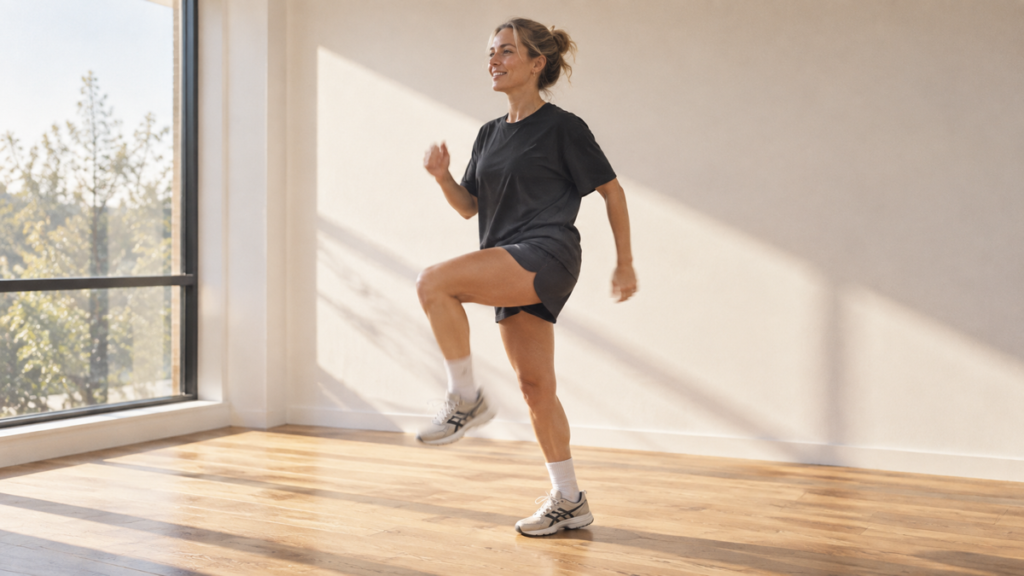
1. March with arm swings
Stand tall and march in place. Let your opposite arm swing with each leg. Begin slowly, then make the steps a little quicker or lift the knees slightly higher if that feels comfortable.
Keep your feet quiet rather than stomping. If you prefer, walk around the room, use an easy treadmill pace, or pedal a stationary bike instead.
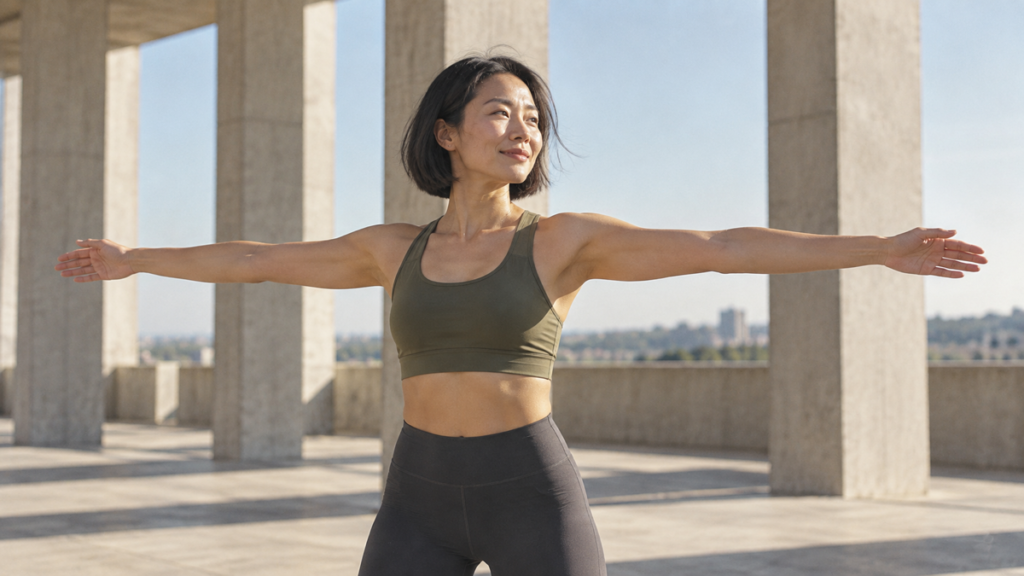
2. Arm circles and open reaches
Extend your arms out to the sides. Make five small circles forward, five backward, then gradually widen them. Next, reach both arms forward as your upper back gently rounds. Open the arms wide and let your chest face forward again. Repeat five times.
Keep your ribs relaxed. The goal is smooth shoulder movement, not the largest circle you can force.
3. Standing torso rotations
Stand with your feet about hip-width apart and your knees soft. Hold your hands in front of your chest. Turn your ribs gently to the right while your hips stay mostly forward, return to center, then turn left.
Move through the upper back instead of swinging your arms for momentum. If your workout includes rotation, add a small controlled reach in the direction you turn.
4. Ankle rocks to calf raises
Stand facing a wall and place your hands on it. Step one foot slightly forward. Keeping the heel down, guide the front knee toward the wall, then return. Alternate sides for four or five rocks each.
Finish with eight slow calf raises: lift both heels, pause briefly, and lower with control. Use the wall for balance. Your ankles should move more comfortably during squats, lunges, walking, and running—not feel pinched or forced.
5. Hamstring sweeps
Place your right heel lightly on the floor in front of you with the toes pointing up. Bend the left knee a little and send your hips back as both hands sweep toward the right foot. Stand, switch legs, and repeat.
Keep your back long and make the range smaller if you need to round forward to reach your foot. This is a moving hip hinge, not a long toe-touch hold.

6. Squat to overhead reach
Stand with your feet in a comfortable squat position. Sit your hips back and bend your knees through an easy range. As you stand, reach both arms overhead without leaning backward.
Start shallow. If your heels lift or your knees feel uncomfortable, reduce the depth or squat toward a stable bench. By the final few repetitions, aim for the range you expect to use in your workout, not a deeper one.
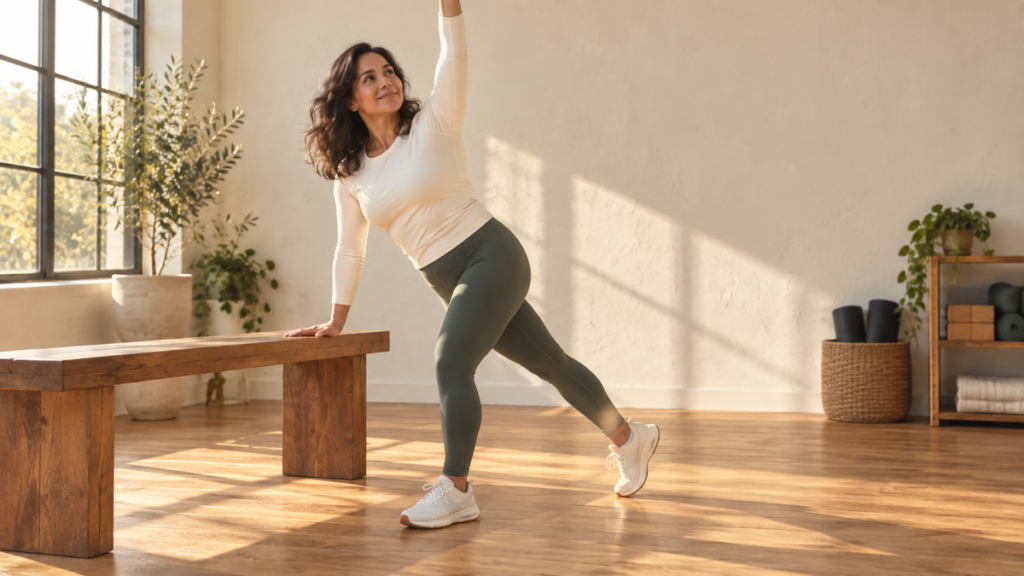
7. Supported reverse lunge and reach
Stand beside a wall or bench. Step your right foot back, bend both knees slightly, and reach your right arm up. Return to standing, then change sides.
Keep most of your pressure through the front foot and use a short step if balance is the main challenge. You can replace the lunge with alternating backward toe taps while keeping the overhead reach.
The NHS beginner warm-up uses the same practical idea: several minutes of marching followed by moving drills such as heel digs, knee lifts, shoulder rolls, and knee bends. That routine is a useful low-impact alternative when lunges or floor space do not fit the day.
Add an activity-specific finish
The same seven movements can prepare your whole body, but the final minute or two should match what comes next. This is the part people often skip, and it is usually more useful than collecting extra stretches.
Before a strength workout
Repeat the first one or two exercises from your session with little or no resistance. Before weighted squats, for example, do several controlled bodyweight squats, then a light set with the same stance and equipment you plan to use. Before a chest press, try wall push-ups or a light practice set on the machine.

Use the warm-up to check your setup and range. If you are new to machines, follow this first full-body machine workout and treat its first light set as rehearsal, not a test.
Still choosing your movements? This list of gym exercises for beginners explains common patterns and manageable starting options. Pick the workout first, then make the last part of your warm-up resemble it.
Before a home workout
Keep the seven-move sequence, then rehearse the first exercise from your video or plan for 5–8 slow repetitions. If the session begins with a squat, push-up, or hinge, choose the easiest version first.
Before a walk, run, or cardio session
Begin with the activity itself at an easy pace. Ease into it: start a walk at a relaxed pace, pedal gently, or walk before transitioning to a run. Add ankle rocks, calf raises, squats, and reverse lunges if those areas will do most of the work.
For a longer run, your training schedule matters more than adding an elaborate stretch circuit. The beginner 10K training plan uses controlled run-walk intervals and an easy effort so the session builds gradually after the warm-up.
Before a class
Arrive a few minutes early and use the pulse raiser plus the movements most similar to the class. For a lower-body class, spend more time on ankle rocks, squats, and lunges. For an upper-body session, add light rows, wall push-ups, or band pull-aparts if the equipment is available.
You do not need to pre-exhaust yourself. If your breathing is already hard and your legs feel heavy, the warm-up has become another workout.
Should you do static stretching before exercise?
Static stretching is not automatically bad before exercise. A brief, comfortable hold may help when you need a specific range of motion. The problem is treating several long, intense holds as the entire warm-up right before heavy lifting, sprinting, or jumping.
A systematic review of stretching and immediate performance found that performance changes after static stretching were more negative when a muscle group was held for 60 seconds or longer than when holds were shorter. Dynamic stretching completed close to the activity tended to have small performance benefits. In the studies that included dynamic activity after stretching, the authors found no clear effect on subsequent performance.
The practical takeaway is simple:
- use dynamic movement as your default before most workouts;
- if one short static hold feels useful, keep it comfortable and follow it with movement;
- save longer flexibility work for after the session or a separate time when flexibility is the main goal.
Do not turn this into a new rule you have to execute perfectly. Ten seconds of a gentle calf stretch will not erase your workout. The sequence and intensity of the whole warm-up matter more than labeling one move “good” or “bad.”
How to choose good pre-workout stretches
The best warm-up is specific enough to prepare you without becoming a project of its own. Use these checks:
- Match the workout. Prepare the joints and movement patterns you will use that day.
- Start smaller than you finish. Increase range, speed, or resistance gradually.
- Stay controlled. Avoid bouncing, yanking, or forcing a joint into its end range.
- Notice the response. You should feel warmer and more coordinated, not exhausted.
- Adjust for the day. Cold weather, an early morning, or a harder session may call for a little more time. A short, easy workout may need less.
Stop the warm-up if you feel pain, dizziness, faintness, chest pressure, unusual shortness of breath, or a clear worsening in how you feel. Do not use deeper stretching to push through a warning sign.
Common warm-up mistakes
Holding every stretch for a long time
Long holds can be useful for flexibility, but they are not the only way to prepare for movement. Keep the pre-workout routine active, then place longer stretching where it supports your actual goal.
Using the same routine for every session
A full-body base is convenient. The finish still needs to change. A lower-body strength day, an upper-body session, and a run ask for different practice movements.
Starting at workout speed
Jumping straight into fast mountain climbers or heavy squats misses the gradual part of warming up. Begin with an easier pace or load, then build.
Forcing a “tight” area
More range is not always better. If a movement pinches, causes pain, or makes you compensate, reduce the range or swap it. A warm-up should help you organize the movement you have today.
Letting the warm-up take over
If a 20-minute workout now requires 25 minutes of preparation, the routine is probably too large. Keep the seven-move version for days when you want full-body coverage. On rushed days, use the three-part formula: two minutes easy, two or three relevant dynamic moves, then one practice set.
FAQ
What are the best stretches to do before a workout?
The best stretches before workout are dynamic movements that match the session: ankle rocks and squats before lower-body work, arm circles and light presses before upper-body work, or easy walking and leg movements before cardio. No single list is best for every workout. Start with the seven-move routine, then make the last minute specific to your first exercise.
What stretches should I do before working out if I only have three minutes?
Spend one minute marching or walking, one minute on the two dynamic movements most relevant to the session, and one minute rehearsing your first exercise. Before a squat workout, that could mean marching, ankle rocks, bodyweight squats, and then a light first set.
Is stretching enough to warm up?
Not always. Stretching may move a joint through a useful range, but a warm-up should also raise your effort gradually and rehearse the activity ahead. Add a short walk, march, or easy cycle plus a lighter version of your first exercise.
How long should I warm up before a workout?
For many general workouts, 5–10 minutes is a practical range. Use more time before a harder session or when you need longer to feel ready. A short, easy workout may need less. Judge the warm-up by whether your breathing, range, and coordination have increased gradually without tiring you out.
Save the sequence, then adjust the finish
Your warm-up does not need novelty. Save these seven movements, repeat them until the order feels automatic, and change only the last one or two minutes to match the session.
That gives you a routine for ordinary days: raise your effort, move through a comfortable range, rehearse what comes next, and start the workout before your available time disappears.