

Decollete Massage: A Gentle 5-Minute Neck and Chest Routine
11 min readYou finish your face routine, put the lid back on your moisturizer, and notice that everything below your jaw has been left out again. Then a video tells you to pull hard up your neck for a “lifted” chest. That is where a simple skin care step starts to feel suspiciously complicated.
A decollete massage can be much simpler. Use clean hands, a little product for slip, and light gliding movements across the upper chest, around the collarbones, over the tops of the shoulders, and down the back of the neck. Five minutes is enough for a first routine.
The realistic goal is comfortable touch, easier product application, and perhaps a brief feeling of warmth or relaxation. This routine is not an evidence-based method for permanently tightening skin, erasing chest lines, changing anatomy, affecting thyroid function, improving breast health, or “detoxing” the body.
What is decollete massage?
In beauty and fashion, the décolletage is the area around the neckline: the upper chest, collarbones, shoulders, and base of the neck. You may also see the practice called décolleté massage. The terms are often used loosely online, so the boundaries matter.
This routine covers the exposed upper chest above the breast line, the skin around—not directly on—the collarbones, the shoulder tops, and the back of the neck. It does not include breast massage, deep pressure on the neck, or pressing over the throat or a pulse point.
It is also different from manual lymphatic drainage. A cosmetic chest-and-neck routine may borrow slow, light strokes, but it does not diagnose swelling, treat lymphedema, or follow a personalized drainage pathway. If you already have aftercare instructions for surgery, an injection, a skin treatment, or another procedure, follow those instructions instead of adding this sequence.
What can the routine realistically do?
A short massage may feel pleasant, make it easier to spread moisturizer evenly, and leave the area feeling temporarily warm. Those are modest benefits, but they are useful if the routine helps you slow down and apply skin care without hurried rubbing.
The sources reviewed for this article do not support the dramatic cosmetic claims attached to décolletage massage. One small study of 17 healthy adults found that a 20-minute therapeutic neck-and-shoulder massage raised skin temperature in several areas, including the front of the upper chest and back of the neck. The study did not test a five-minute home routine, skin firmness, wrinkles, lymph flow, or lasting changes in appearance.
That distinction is the whole game. Temporary warmth after touch is plausible. The sources reviewed here do not support promises of a permanently lifted neckline.
Massage research also covers many different techniques and goals. The National Center for Complementary and Integrative Health notes that massage involves many types of soft-tissue manipulation and that rare serious harms have been reported, particularly with vigorous techniques or in people at higher risk of injury. For that reason, this beginner routine avoids vigorous pressure. As a separate conservative route choice, it uses light glides over the back of the neck and leaves the throat and pulse areas alone.
Before you begin
You do not need a special oil, sculpting tool, or complicated setup. Your hands are enough, and they give you immediate feedback when the pressure starts to creep up.
Use this quick checklist:
- Wash and dry your hands, including under your nails.
- Remove necklaces, rings, or bracelets that could catch or scratch.
- Start with clean skin and smooth nails.
- Apply a small amount of moisturizer, balm, or facial oil that your skin already tolerates.
- Pull hair away from your neck without making your posture stiff.
- Sit or stand with your shoulders relaxed and your chin level.

The product should let your palms glide without dragging. More is not automatically better. Add a small amount only if your hands skip or tug.
If the product is new, test it before turning it into massage slip. The American Academy of Dermatology recommends applying a new skin care product to a small test area twice daily for seven to ten days and watching for redness, itching, or swelling before wider use. Its product-testing instructions explain where to test a product, how often to apply it, and which reactions to watch for.
Check the skin, not just the clock
Skip the routine over sunburn, a rash, open cuts, active irritation, bruising, or skin that feels unusually tender. Do not massage skin that is still recovering from a peel, laser, injection, surgery, or another recent treatment; use the aftercare timing you were given.
If the skin you plan to massage has rosacea, skip massage over that area; the American Academy of Dermatology advises avoiding rubbing, scrubbing, or massaging rosacea-prone skin.
Stop the routine if you notice pain, burning, numbness, dizziness, nausea, trouble breathing, bruising, or redness that keeps building rather than settling. A relaxing step should not become something you have to push through.
A five-minute decollete massage technique
This sequence uses broad hands and slow movements. Think “apply and glide,” not “dig and sculpt.” Keep your hands on the skin rather than repeatedly lifting and landing, and let each pass become a little slower and lighter.
The five-minute plan
Allow 30 seconds to apply slip, one minute each for the upper chest, collarbones, shoulder tops, and back of the neck, then 30 seconds to finish.
1. Apply your slip for 30 seconds
Warm a small amount of your chosen product between your palms. Rest both hands flat on the upper chest, well above the breast line, then spread the product from the center outward toward the shoulders.
Use the whole palm where it feels comfortable. Fingertips tend to concentrate pressure, which is not needed here.
2. Glide across the upper chest for 60 seconds
Place one palm near the center of the upper chest. Sweep slowly outward toward the opposite shoulder, staying on the flat area below the collarbone. Alternate hands in an easy rhythm.
Keep the movement shallow. Your skin may move slightly with your hand, but it should not bunch, sting, or turn sharply red. Three or four slow passes on each side are plenty.

3. Frame the collarbones for 60 seconds
Place the pads of two or three fingers just below one collarbone. Glide from the center outward toward the shoulder with barely more pressure than you would use to apply moisturizer.
Repeat just above the collarbone if that area feels comfortable, but do not grind directly over the bone. Keep your fingers away from the hollow at the base of the throat. Switch sides after a few slow passes.

4. Soften the shoulder tops for 60 seconds
Cup your right shoulder with your left hand. Use broad, slow circles over the fleshy top of the shoulder, then sweep outward toward the upper arm. Repeat on the other side.
This step belongs on the shoulder muscle, not the front or side of the neck. Let the shoulder drop instead of pulling it up to meet your hand.

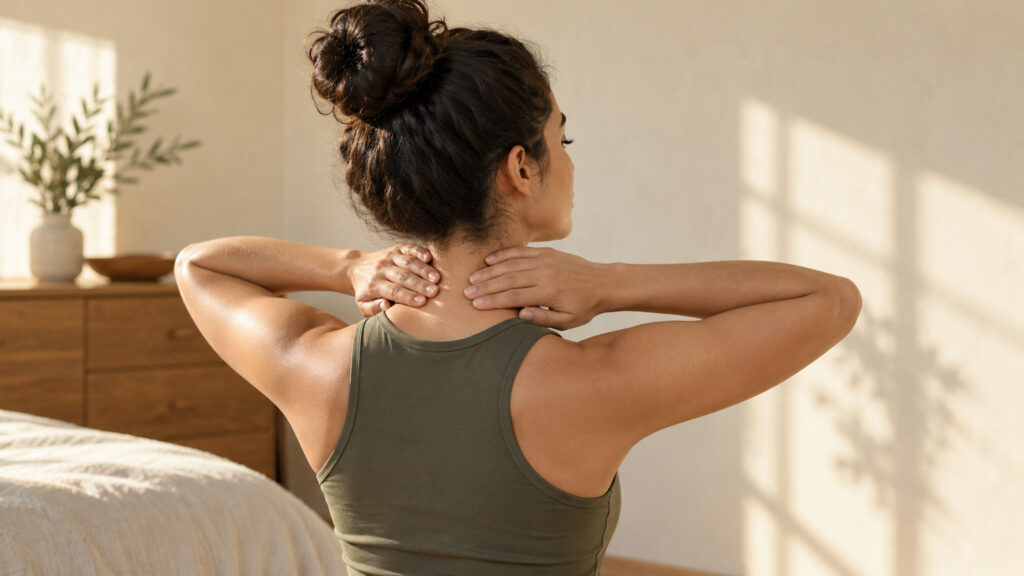
5. Glide down the back of the neck for 60 seconds
Place both hands at the back of your neck, below the base of the skull. Use open fingers to glide down and outward toward the shoulders. Keep the pressure gentle and the chin level.
Do not wrap your fingers around the throat. Do not pinch the sides of the neck, search for a pulse, or use a tool here. If reaching the back of your neck makes you tense your arms, skip this step and repeat the shoulder circles instead.
6. Finish with light chest sweeps for 30 seconds
Return both palms to the upper chest. Make two or three feather-light sweeps from the center toward each shoulder, then lift your hands away.
Your skin may feel warm, but it should not feel sore or look scraped. Blot excess product if needed rather than rubbing it off.
How much pressure should you use?
For this routine, light means you can feel your hand moving over the skin without pressing into the deeper tissues underneath. Your breathing stays normal. Your neck does not feel compressed. You do not see finger-shaped marks afterward.
A gentle neck-and-décolletage routine needs clear boundaries. Keep the movements superficial: work across the upper chest, shoulder tops, and back of the neck, and do not press over the throat or any place where you feel a pulse.
Use these cues while you practice:
- Comfortable: the hand glides easily, the skin stays calm, and the movement feels broad.
- Too much friction: your fingers drag, the skin pulls, or the product pills. Add a little slip or stop.
- Too much pressure: you hold your breath, feel pain, notice a pulse under your fingers, or leave marks. Lift your hand and reset elsewhere.
There is no prize for making the routine intense. A firmer touch does not turn it into a lifting treatment.
Which direction should you massage?
Online diagrams often insist that every stroke must move upward to fight gravity or downward to “drain toxins.” Neither claim gives you a useful reason to tug at your skin.
For this routine, direction is about comfort and control:
- move from the center of the upper chest outward so your hands have room to finish at the shoulders;
- follow the collarbone from the center toward the shoulder without pressing on the bone;
- move from the back of the neck down and outward toward the shoulder tops;
- avoid sweeping across the throat or pressing into the side of the neck.
These directions create a repeatable skin care routine. They are not a promise of lymphatic drainage, lasting lift, or wrinkle removal.
Can you include your face?
A face, neck, and décolletage massage is simply a longer routine that works across several areas. You do not need to join everything into one continuous sequence, and using more steps does not make the results more permanent.
Finish this chest-and-neck routine first. If your skin still feels comfortable and you want to continue above the neck, use a separate gentle jawline massage routine with fresh slip and lighter pressure near the face. Keeping the sections separate makes it easier to notice where friction or soreness starts.
Tools are optional. Starting with your hands makes it easier to adjust pressure and notice friction around the collarbones and neck. If you want to learn the tool separately, start with this beginner guide to gua sha for face and keep the chest-and-neck route hands-only for now. Never drag a hard edge over the throat, pulse area, collarbones, or breast tissue.
Common mistakes that make the routine less comfortable
Pulling upward as hard as possible
“Upward” is often presented as a lifting instruction. In practice, hard upward pulling mostly adds friction. Reduce the pressure until your hand glides without stretching the skin into a tight fold.
Working on dry skin
Dry massage can feel scratchy and make you compensate by pressing harder. Use a thin layer of a familiar product and add more only if your hands start to drag.
Treating the front of the neck like a tight muscle
The throat and pulse areas are not places for deep self-massage. Keep cosmetic strokes superficial and route them across the upper chest, shoulders, and back of the neck.
Massaging irritated or freshly treated skin
Massage is extra friction. If your skin is sunburned, inflamed, recently treated, or reacting to a product, give it time and follow the aftercare already provided.
Expecting massage to replace skin care
Massage does not protect exposed skin from ultraviolet radiation. The AAD recommends a broad-spectrum, water-resistant sunscreen with SPF 30 or higher and says to cover all exposed skin, including the neck. Its sunscreen application guide also explains when to apply and reapply it.
Chasing a visible transformation every time
Some days the routine may feel relaxing. Other days it may just feel like a slower way to apply moisturizer. Both are normal. A before-and-after photo is not required for the habit to be worthwhile.
How often can you do decollete massage?
The sources reviewed here do not establish an ideal schedule for this specific cosmetic routine. Start with one short session and see how your skin responds over the next day. If it stays calm and you enjoy the practice, you can repeat it when it fits your routine.
Daily massage is not a requirement. More sessions do not guarantee firmer skin or faster results. If you use retinoids, exfoliating acids, or another product that already makes the area dry or sensitive, choose a different time or skip massage when the skin feels reactive.
On a busy night, you can skip the full routine. Apply moisturizer with two broad outward sweeps across the upper chest and stop there. Consistency does not have to mean completing every step.
FAQ
Is this a lymphatic drainage routine?
No. This is a gentle cosmetic massage for the surface of the upper chest, shoulders, and back of the neck. It does not map a clinical drainage pathway or treat swelling.
Should the strokes always move upward?
No. Upward movement is not required for a lifting effect. In this routine, upper-chest strokes move outward toward the shoulders, while back-of-neck strokes move down and outward. Comfort and light pressure matter more than an “anti-gravity” direction.
Can I massage the sides of my neck?
Keep pressure away from the throat and pulse area. This routine uses the back of the neck and shoulder tops instead. If a movement makes you feel dizzy, numb, breathless, or uncomfortable, stop.
Do I need a gua sha tool?
No tool is required. Starting with your hands makes it easier to adjust pressure and notice friction around the collarbones and neck.
Keep the next session simple
The most useful decollete massage is not the one with the most arrows. It is the one you can repeat without dragging your skin, pressing into your throat, or expecting a permanent lift.
Start with clean hands, familiar slip, and five minutes. Work across the upper chest, frame the collarbones lightly, circle the shoulder tops, and glide down the back of the neck. If your skin or body tells you to stop sooner, that is a successful adjustment—not a failed routine.