You walk onto the gym floor, see three rows of machines, and realize “do a workout” is not nearly specific enough. Which seat moves? Where does the pin go? Is that person still using the leg press?
You are not bad at the gym. You are simply being asked to make too many new decisions at once.
Here is your gym beginner workout: warm up for five minutes, complete one set of 8–12 controlled reps on six machines, rest as long as you need to repeat good form, and leave with the settings written down. The first session will usually take 30–40 minutes. Its job is to make your next visit easier, not to test how much discomfort you can tolerate.
Before your first gym day
This plan is for a generally healthy adult who is new to resistance training and wants a simple introduction to common weight-stack machines. It is not a rehabilitation plan or an individual prescription.
Get personalized guidance before starting if you have an injury, ongoing pain, a chronic condition, significant symptoms, or need pregnancy or postpartum modifications. Stop the workout if you feel pain, faintness, dizziness, chest pressure, an irregular or racing heartbeat, or unusual shortness of breath. Seek urgent medical help for severe or sudden symptoms.
For your first gym day, keep the preparation basic:
- save this routine on your phone or write the six machines in your notes;
- wear clothes you can move in and secure, comfortable shoes;
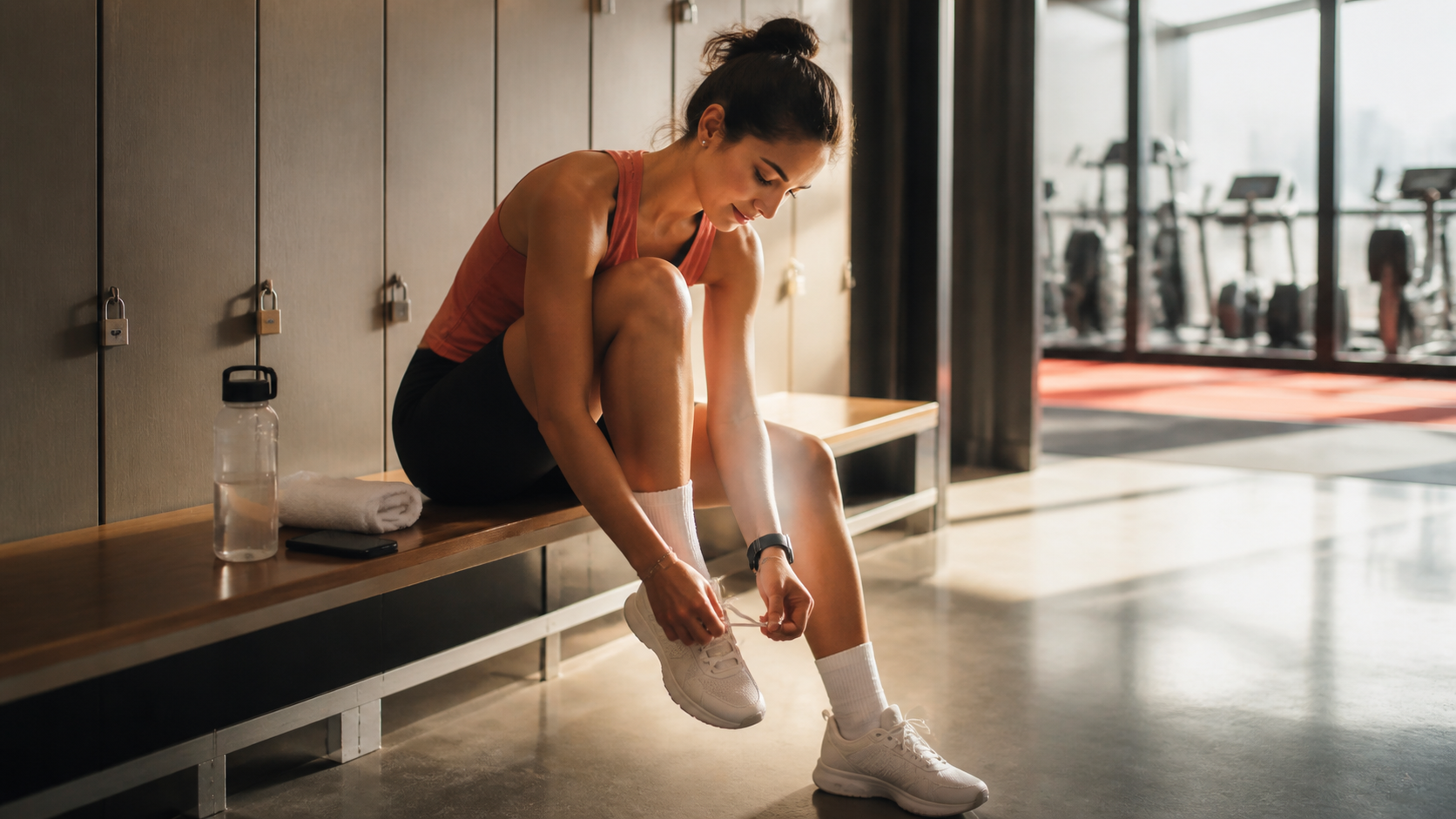
- bring water plus any towel, locker token, or lock your gym requires;
- ask whether a staff member can show you how to adjust the machines;
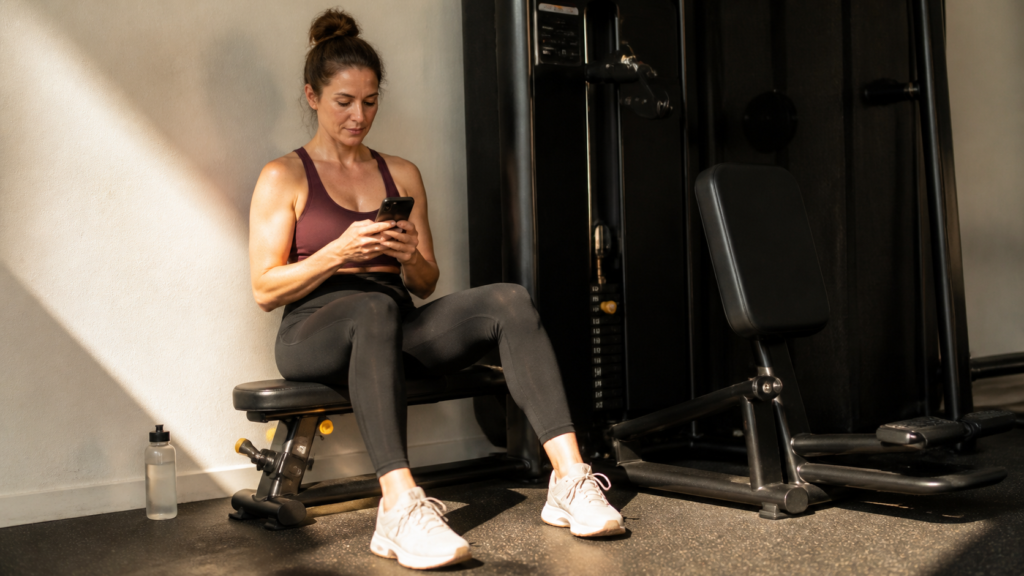
- plan to record the seat setting, weight, and reps after each exercise.
A gym orientation is useful even if you do not want personal training. Five minutes spent finding the adjustment levers can save an entire session of guessing.
Your gym workout for first timers at a glance
Start with five minutes of easy walking or cycling. You should feel warmer, but you should still be able to talk comfortably. Then do the machines in the order below.
On your first visit, complete one work set per exercise. Rest for about 60–120 seconds, or longer if your breathing and muscles are not ready. There is no prize for rushing between machines.
| Exercise | Main focus | First-visit target | One setup check |
|---|---|---|---|
| Leg press | Thighs, glutes, hips | 1 × 8–12 | Feet stay flat and your knees bend comfortably |
| Seated leg curl | Back of thighs | 1 × 8–12 | The machine pivot sits close to your knee joint |
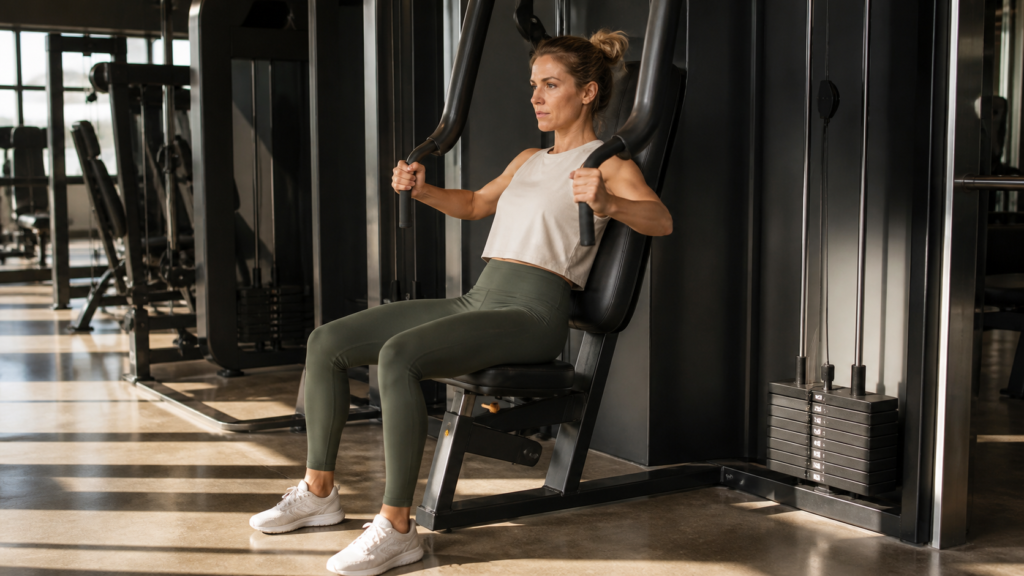
| Seated chest press | Chest, shoulders, triceps | 1 × 8–12 | Handles begin around mid-chest height |
| Seated row | Upper back, shoulders, biceps | 1 × 8–12 | You can reach the handles without rounding forward |
| Lat pulldown | Back and arms | 1 × 8–12 | Thigh pad holds you down without pinching |
| Machine shoulder press | Shoulders and triceps | 1 × 8–12 | Handles start near shoulder height in a comfortable range |
This beginner gym workout with machines trains the main lower-body, pushing, and pulling patterns without asking you to learn a barbell lift on day one. It is a starting template, not the only valid routine. Machine names and designs vary, so use the instruction label on the exact model and ask gym staff when its setup differs from the cues below.
If six machines feel like too much, do the leg press, leg curl, chest press, and seated row. Four controlled exercises are more useful than six rushed ones.
How to choose your starting weight
The number printed on the weight stack is not a grade. Different machines can feel completely different, even when the labels show the same weight.
Use this quick test for each exercise:
- Set the pin at a light resistance and make sure it is fully inserted.
- Do five slow test reps through a comfortable range.
- If you could easily do many more, move the pin up by the smallest available step.
- Begin your work set and stop with about two or three good reps still possible.
The final reps should require focus, but they should look similar to the first ones. Lower the weight if you have to jerk the handles, shorten the movement suddenly, hold your breath, or move your body away from the pad.
You do not need to train until you cannot complete another rep. The 2026 American College of Sports Medicine position stand found that training to momentary muscle failure did not consistently improve outcomes for the average healthy adult.
How to set up any gym machine without guessing
Most selectorized machines use the same basic process: adjust your position, choose the resistance with a pin, and move the handles or pad through a guided path. The details still matter.
Before every exercise:
- Read the machine label. Check the pictured setup, adjustment points, and direction of movement.
- Adjust before adding effort. Position the seat, back pad, chest pad, or thigh pad for your body. Never copy the previous person’s settings without checking them.
- Secure the pin. Keep your fingers away from the moving weight stack and confirm the selector pin is fully seated.
- Practice the path. Use a light resistance for a few reps. Move only through a range that feels controlled and free of pain.
- Keep the return controlled. Do not let the plates crash together. Keep breathing; many people find it natural to exhale during the effort and inhale as the weight returns.
A machine guides the resistance, but it does not know your limb length, injury history, or comfortable range. If you cannot make the setup fit, choose another model or ask for help instead of folding yourself into it.
How to do the six exercises
1. Leg press
Sit with your back and hips supported. Place your feet about hip-width apart on the platform. Bend your knees only as far as you can while keeping your feet flat and your hips steady, then press the platform away without snapping your knees straight.
Make it easier: reduce the resistance or use a smaller comfortable range. Stop and reset: if your heels lift, your hips curl away from the pad, or your knees feel painful.
2. Seated leg curl
Adjust the seat so the machine’s pivot is close to the side of your knee. Place the lower pad above your heels or against the lower calves, depending on the model. Keep your hips and back supported as you bend your knees, then return slowly.
Make it easier: lower the weight and shorten the range. Stop and reset: if the pad sits on your heel, the seat pin is loose, or you have to swing your torso.
3. Seated chest press
Adjust the seat so the handles start around mid-chest height. Keep your feet planted, wrists straight, and back supported. Press forward without shrugging your shoulders, then let the handles return with control.
Make it easier: choose a lighter setting or stop before the deepest part of the return. Stop and reset: if you feel shoulder pain or cannot keep your wrists in line with your forearms.
4. Seated row
Set the seat or chest pad so you can reach the handles with long arms and a tall torso. Pull your elbows back toward your sides. Pause briefly, then straighten your arms without letting the weight pull your shoulders far forward.
Make it easier: reduce the resistance and use the chest support if the machine has one. Stop and reset: if you have to lean back or jerk the handles to finish a rep.
5. Lat pulldown
Sit with the thigh pad snug above your legs. Hold the bar a little wider than shoulder width, or use the machine’s neutral-grip handles. Pull toward your upper chest while keeping your torso mostly upright, then return until your arms are long but controlled.
Make it easier: lower the weight or use a neutral grip if available. Stop and reset: if you pull the bar behind your neck, swing backward, or feel pain in your shoulders or elbows.
6. Machine shoulder press
Adjust the seat so the handles start close to shoulder height. Keep your back supported and wrists stacked over your forearms. Press upward through a comfortable range, then lower without dropping the stack.
Make it easier: use less resistance or a shorter range. Skip it today: if overhead movement is uncomfortable. The workout still counts without it.
What to do when the gym is busy
The machine you need will eventually be occupied. This is a scheduling problem, not a reason to abandon the session.
- Move to the next exercise and come back later.
- Use another machine with the same movement label, then adjust it from scratch.
- Ask a staff member for the closest simple alternative.
- Do one set instead of two when you are short on time.
- If only 20 minutes are available, warm up and complete the leg press, chest press, seated row, and leg curl.
The most useful easy gym workouts for beginners include an exit ramp. A shorter version planned in advance keeps a packed floor or late meeting from making the decision for you.
How to repeat and progress this simple gym workout
Repeat the routine on two nonconsecutive days each week, such as Tuesday and Friday. Current U.S. guidance recommends muscle-strengthening work for all major muscle groups on at least two days a week. Treat that as a direction to build toward, not a demand to perfect every muscle group in your first session.
Use this progression for your first four visits:
- Visit 1: one set per exercise; learn the room and record your settings.
- Visit 2: repeat the same weights; add a second set to two exercises if you feel ready.
- Visit 3: work toward two sets on the exercises that still feel controlled.
- Visit 4: if you complete 12 clean reps in both sets and could do two or three more, add the smallest weight increase next time.
Change one detail at a time. Adding weight, sets, reps, and extra workout days together makes it hard to tell what your body is responding to.
If soreness or fatigue interferes with normal daily tasks, keep the next visit lighter or repeat the previous one. If you miss a week, return to the last settings that felt manageable. You do not need a punishment workout to restart.
Common first-timer mistakes
- Using someone else’s seat settings. Your setup should match your body, not the person who trained before you.
- Starting with a weight you hope is right. A light test set gives you better information than a guess.
- Racing the weight back down. Control both directions and keep the plates from slamming.
- Forcing a textbook range. Use the largest pain-free range you can control; a machine diagram cannot assess your joints.
- Changing the routine every visit. Repeating the same small group of movements lets you learn the setup and notice progress.
- Staying until you are exhausted. Your first workout has done its job when you have practiced the plan and know what to repeat.
FAQ
What should a beginner do at the gym?
Begin with a short warm-up and a repeatable full-body strength routine. One set of six machine exercises is enough for a useful first visit. Learn the setup, keep two or three reps in reserve, and record what you did.
How long should a beginner’s first gym workout be?
About 30–40 minutes is practical for this plan: five minutes to warm up, roughly 20–30 minutes for the machines, and a few minutes to slow down and make notes. If you need longer to adjust equipment or ask questions, that is part of the workout too.
How many days a week should a beginner go to the gym?
Two nonconsecutive strength days are a simple starting point and align with current guidance for muscle-strengthening activity. You can walk, cycle, or do other aerobic activity on different days, but your first week does not need a complicated split.
If you want to place those sessions inside a broader week, this guide to how to start working out combines short strength and cardio sessions into a realistic weekly plan.
Are machines or free weights better for beginners?
Neither is automatically better. Machines can reduce the balance and setup demands of some exercises, which may make the first sessions easier to follow. Free weights offer more movement options. Since equipment type does not significantly impact results for the average healthy adult, pick whichever option allows for good control and regular execution.
What if I cannot finish every machine?
Stop when you need to. Complete the four-machine short version or end the session after the exercise you are on. Missing one movement will not erase the work you did, and you can try the full list next time.
Your next step
Save the six-machine list before you leave home. At the gym, ask for help with the first seat adjustment, start lighter than your ego suggests, and write down each setting as you go.
Your win for the day is simple: you leave knowing exactly what to repeat. That is how a room full of unfamiliar equipment starts to feel like a routine.