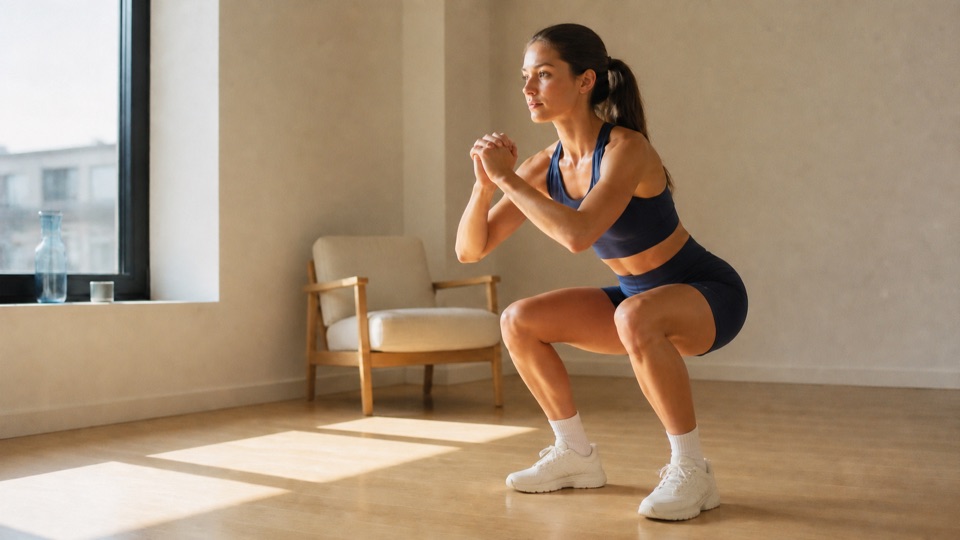
You have 20 minutes, a patch of floor, and no desire to turn your living room into a mini gym. Good. That is enough to begin.
This bodyweight exercise program for beginners uses six simple movements, two full-body sessions a week, and a four-week progression. Start with one round. Build to two. Choose the easiest version that lets you move with control. You do not need to finish shaky, breathless, or sore for the workout to count.
Is This Program Right for You?
This plan may suit you if you are new to strength training, returning after a break, or looking for a simple routine you can do at home without fitness equipment. It works best if you can set aside 15–25 minutes twice a week and want to learn the basics before adding more challenge.
This plan is not designed for advanced strength or muscle-building goals, sport-specific training, or rehabilitation. If you have an injury, ongoing pain, a chronic condition, significant symptoms, or need pregnancy or postpartum modifications, get individual guidance from a qualified health professional before starting. A no-equipment plan also cannot fully replace loaded pulling exercises such as rows.
How the Program Works
Do the workout on two nonconsecutive days, such as Monday and Thursday. Each session takes about 15–25 minutes. Wear shoes or train barefoot only if the surface feels secure, and keep water nearby.
Before each session, warm up for 3–5 minutes. March in place, roll your shoulders, practice a few shallow squats, and move your hips and ankles through a comfortable range.
In this bodyweight exercise routine for beginners, complete the six exercises in order. Rest for 30–60 seconds between exercises and 60–90 seconds between rounds. Longer rest is fine if it helps you keep good form.
| Exercise | Reps | Make it easier | Next step |
|---|---|---|---|
| Bodyweight squat | 6–12 | Use a smaller range or lightly hold a wall | Pause near the bottom |
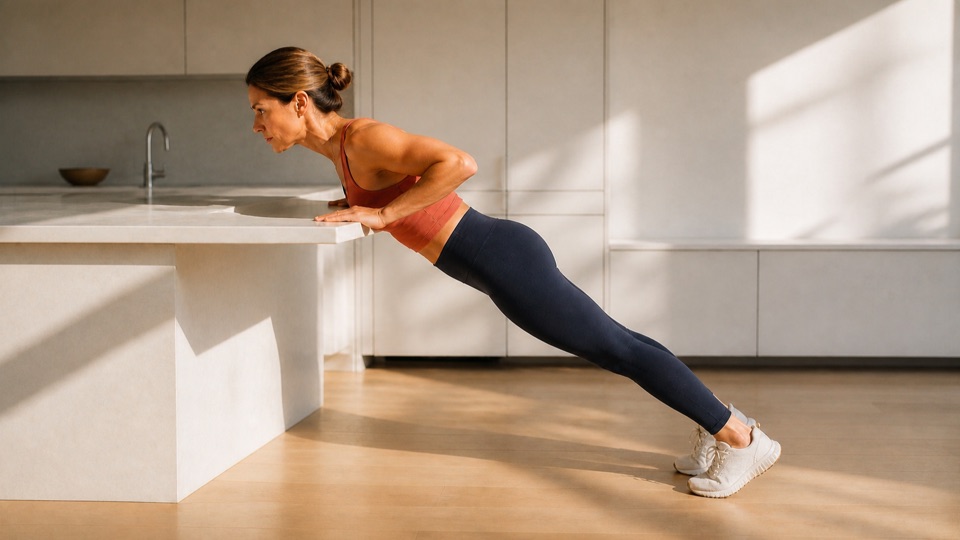
| Wall push-up | 6–12 | Stand closer to the wall | Move to a stable counter, then the floor |
| Supported split squat | 5–10 reps per side | Use a shallow range and hold a wall | Use less hand support |
| Glute bridge | 8–15 | Shorten the range | Pause for two seconds at the top |
| Bird dog | 5–10 reps per side | Move one limb at a time | Reach the opposite arm and leg together |
| Prone W raise | 6–12 | Keep your hands on the floor | Lift your hands slightly while keeping your neck relaxed |
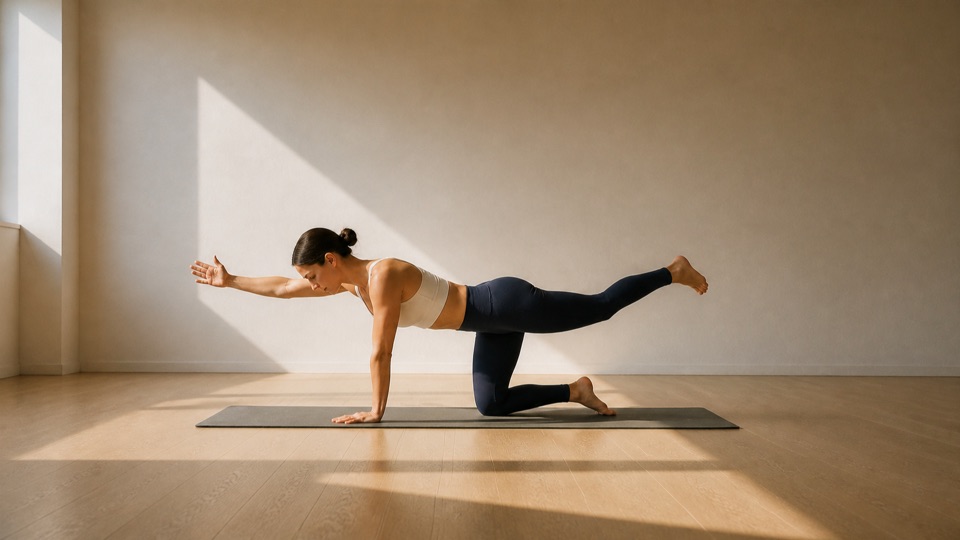
This workout routine for beginners without equipment covers a squat, push, single-leg pattern, hip extension, core control, and upper-back movement. One honest limitation: without a band, bar, or weight, it is hard to train a true pulling pattern. The prone W raise is useful practice, but it is not the same as a loaded row. If you continue beyond this first month, a resistance band can fill that gap.
See step-by-step instructions for all six exercises.
The 4-week beginner bodyweight workout program
This beginner bodyweight workout program adds work gradually. It is a template, not a deadline. Repeat a week if the next step feels too large.
| Week | Frequency | Rounds | What changes |
|---|---|---|---|
| Learn | 2 days | 1 | Use the lowest end of each rep range and learn the movements. |
| Add a round | 2 days | 2 | Keep the same exercise versions and take the full rest you need. |
| Add reps | 2 days | 2 | Add 1–2 reps only where your current reps feel controlled. |
| Progress | 2-3 days | 2 | Add reps or choose a harder version for one or two exercises—not both. |
At every stage, finish each set when you feel you could still do about 2–3 controlled reps. If your form changes or the next week feels like too much, return to the previous version or repeat the week.
The current U.S. physical activity guidance recommends muscle-strengthening activity on at least two days each week. This plan covers that part of the guidance. Adults are also advised to work toward 150 minutes of moderate aerobic activity each week, but you do not have to jump from zero to the full amount. Walking and other short bouts can be added gradually.
What results can you expect after four weeks?
Four weeks is a practice phase, not a transformation deadline. By the end of the plan, you may be able to:
- perform the six movements with more familiar, controlled technique;
- build the habit of completing two short strength sessions most weeks;
- increase your training volume from one round to two and gradually add reps;
- feel more confident choosing an easier or harder exercise version.
Visible changes are not guaranteed, and results vary. The most useful outcome is knowing how to complete and adjust a basic workout without guessing what to do next.
How to progress after Week 4
A useful bodyweight workout plan for beginners changes only when the current version stops feeling challenging. You have several options:
- Add 1–2 reps within the listed range.
- Add a brief pause at the hardest point.
- Use a slightly harder exercise variation.
- Add a third round if you have the time and recover well.
- Add a resistance band to train pulling movements.
Change one thing at a time. You do not need to rush toward jump squats, burpees, or training to failure. Current resistance-training evidence supports progressive practice and consistency; reaching momentary muscular failure is not required for the average healthy adult to make progress.
Track the exercise version, reps, and rounds after each workout. If you can reach the top of the rep range with steady form in two sessions, try one small progression next time.
Common beginner mistakes
- Starting with the hardest version. The right variation is the one you can control today.
- Racing through the reps. Slow down enough to notice your balance and joint position.
- Turning every session into cardio. Rest supports better repetitions; it is not wasted time.
- Adding everything at once. More reps, rounds, speed, and harder variations together make it difficult to judge what your body tolerates.
- Doubling up after a missed day. Resume at the next practical time. One busy week does not erase the work you have done.
FAQ
Can beginners build strength with bodyweight exercises?
Yes. Bodyweight training can help beginners build strength, especially when you are new to exercise. The key is to make the movements gradually more challenging over time—by adding reps, improving control and range of motion, or progressing to a harder variation when the current one feels comfortable.
How many days a week should a beginner train?
Two nonconsecutive full-body sessions are a practical start and align with the recommendation to train major muscle groups at least twice a week. More is not automatically better. Add a third day only if you feel recovered and can keep the same movement quality.
What if I cannot do a floor push-up?
Start at the wall. Move to a stable counter when 12 controlled wall push-ups feel manageable. A floor push-up is a later option, not an entry requirement.
Your next step
Put two 20-minute sessions on your calendar and do Week 1 exactly as written. This bodyweight exercise program for beginners gives you a clear place to start and a simple way to progress without rushing. If you finish thinking, “I could have done more,” that is not a failed workout. It is a sensible first dose—and a plan you can return to is more useful than one dramatic Monday.