

Dry Brush for Lymphatic Drainage: What It Can and Cannot Do
11 min readYou are standing in the bathroom with a wooden body brush in one hand and a saved “detox” routine on your phone. The arrows point toward your heart. The caption promises smoother skin, better circulation, less puffiness, and a fully activated lymphatic system before breakfast. That is a lot of responsibility for one brush.
Using a dry brush for lymphatic drainage is popular, but direct evidence that body brushing improves lymph flow is limited. What dry brushing can reliably do is mechanically exfoliate the surface of your skin. It may also feel pleasant and leave the brushed area temporarily warm or pink. There is no good evidence that dry brushing detoxes the body, treats lymphedema, removes fat, erases cellulite, or reshapes the body.
If you still enjoy the ritual, keep it simple: choose a gentle body brush, use short light strokes on dry, intact skin, and stop before your skin feels sore or looks persistently red. You do not need an aggressive full-body routine to make a three-minute skin-care habit count.
What is dry brushing?
Dry brushing means moving a dry-bristled body brush over dry skin. There is no cleanser, oil, or water involved during the brushing itself. The bristles create friction and lift some loose surface flakes, so the practice is best understood as a type of mechanical exfoliation.
That distinction matters. The American Academy of Dermatology describes mechanical exfoliation as using a tool such as a brush, sponge, or pad to remove dead cells from the outer layer of skin. It also recommends short, light strokes and warns that over-exfoliating can leave skin red and irritated.
Online, dry brushing is often presented as a wellness treatment rather than ordinary body care. You may see elaborate maps, firm pressure, long daily sessions, or claims that the brush pushes toxins out through your pores. Those details are not required for exfoliation, and the bigger health promises are not supported by good direct evidence.
What are the realistic benefits of dry brushing?
Searches for “dry brush massage benefits” often lead to dramatic claims, but the useful effects are modest. That does not make the routine pointless; it simply gives your brush a job it can actually perform.
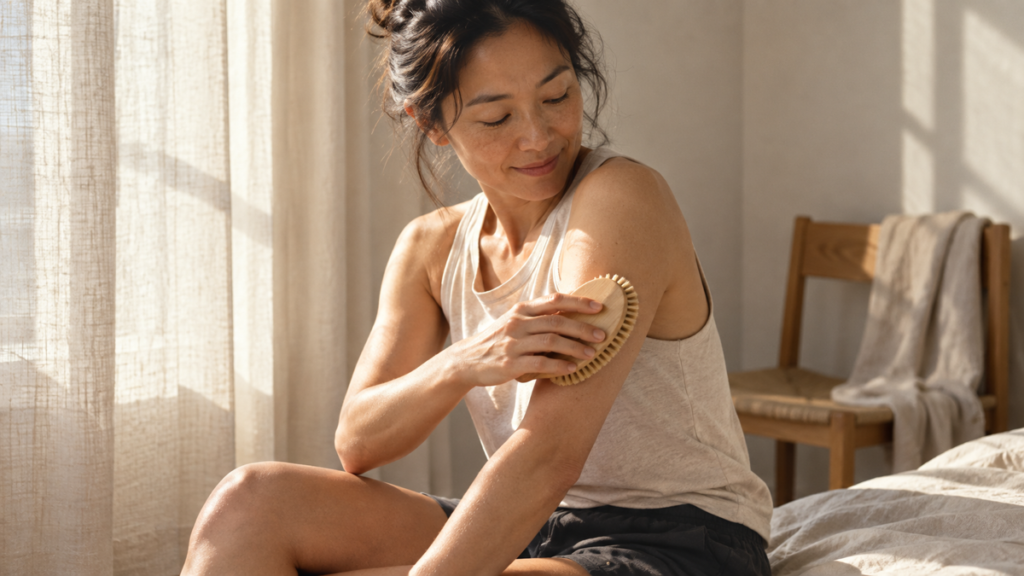
Smoother-feeling skin
The bristles can loosen dry surface flakes. Right after brushing and moisturizing, skin may feel smoother because you have combined light exfoliation with hydration.
The effect is cosmetic and temporary. Your skin continues its normal renewal process, so one session does not permanently change its texture. More pressure will not create a better result. It is more likely to create irritation.
A short sensory ritual
Some people like the steady touch and the few quiet minutes before bathing. If the practice helps you slow down and notice where your skin feels dry or sensitive, that can be a perfectly reasonable reason to keep it.
You do not need to turn relaxation into a biological claim. Feeling refreshed after a routine is different from proving that the routine changed your lymphatic or immune function.
Temporary warmth or pinkness
The brushed area may feel briefly warm or look mildly pink. Direct research on dry brushing and circulation is too limited to support a lasting blood-flow claim. Brief warmth or pinkness after brushing should not be treated as proof of improved circulation.
If dry brushing for blood circulation is your main goal, treat brief warmth as a local, temporary response—not evidence that the brush has corrected a circulation problem. Burning, pain, or redness that stays is a cue to stop, not a sign that the routine is “working.”
Does a dry brush for lymphatic drainage actually work?
This is where the marketing runs ahead of the research. Direct clinical studies of dry body brushing are sparse, and there is no established dry-brushing protocol proven to improve lymphatic drainage in healthy people.
“Lymphatic system dry brushing” is a popular search phrase, not a standardized clinical technique. Brushing toward the torso may give your routine a tidy direction, but the arrows themselves do not prove that you are moving a measurable amount of lymph fluid or clearing toxins.
A warm patch of skin or a pile of loose flakes does not show that waste has left your body. Sweating and exfoliation are not evidence of detox. A brush also cannot diagnose or treat swelling.
Is dry brushing the same as lymphatic drainage massage?
No. Manual lymphatic drainage, or MLD, is a specialized form of skin massage used in lymphedema care. Cancer Research UK describes MLD as very light, slow, rhythmic skin movements performed in a planned sequence. It may be combined with compression, exercise, and other parts of lymphedema treatment.
You may also see videos labeled “dry brush lymphatic massage,” but bristle brushing is not MLD. Dry brushing should not be used to treat lymphedema, persistent swelling, or swelling after surgery.
The body routine below is for gentle surface exfoliation. It is not a medical drainage sequence. If your interest is specifically the face rather than the body, our lymphatic facial massage guide explains the separate hands-only technique and its limits.
Choose a body brush that feels gentle
You do not need a brush with a dramatic product name. Products marketed as a “lymphatic drainage brush” or “lymph massage brush” are still body brushes; the labels do not prove a lymphatic effect.
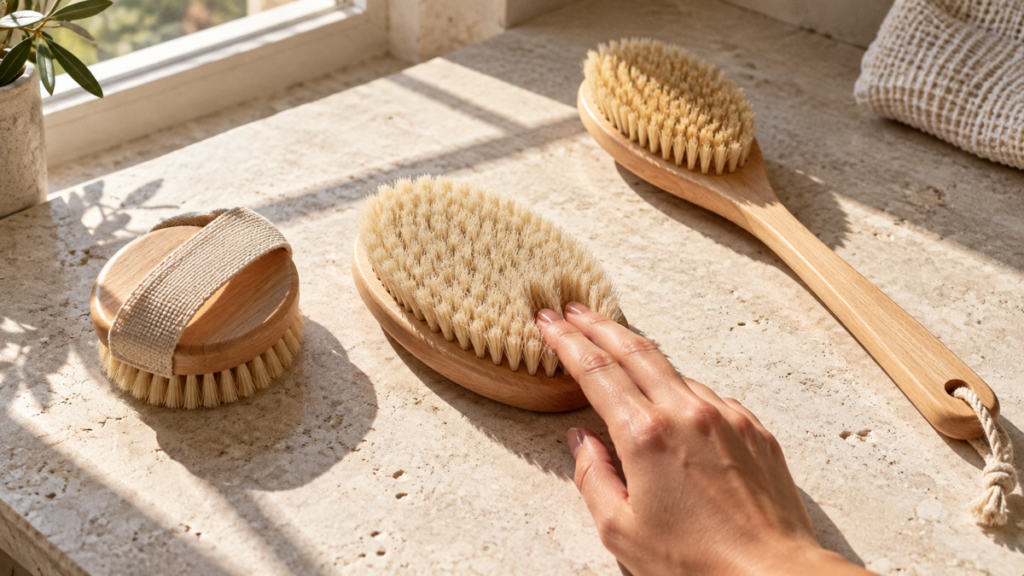
Look for:
- bristles that feel firm enough to sweep the skin but not sharp or scratchy;
- a head that sits securely in your hand;
- a long handle only if it helps you reach your back without twisting;
- a material you can clean and dry completely;
- smooth edges with no loose staples, splinters, or broken bristles.
Test the brush on a small area of your lower leg. Make two light strokes. The test strokes should not sting, burn, or leave scratch marks.
Keep a body brush on the body. Facial skin needs a different level of pressure and a tool designed for that area. If you meant to build a face routine, use our beginner gua sha guide for the face instead of taking stiff body bristles above your neck.
Before you begin
Dry brushing is easiest before bathing, when your skin and the brush are both dry. Set aside three to five minutes rather than starting a long routine you will rush halfway through.
Use this quick check:

- Brush only clean, intact body skin.
- Skip open, broken, sunburned, bruised, infected, or actively irritated areas.
- Skip patches that are flaring, itchy, or already peeling.
- Avoid fresh shaving, waxing, or another exfoliating product in the same area that day.
- Skip dry brushing on an area where a product or medication is already causing peeling, stinging, or extra sensitivity.
- Leave moles, raised lesions, and any spot that catches on the bristles alone.
- Keep the brush away from the face, throat, breasts, genitals, and other delicate skin.
Pressure should feel like a light sweep, not a scratch. You should not have to grip the handle hard or tense your shoulder to create the stroke.
A gentle three-minute dry brushing routine
There is no research-backed stroke map or exact dose for cosmetic dry brushing. This sequence simply gives you an easy order so you do not scrub one area repeatedly while deciding where to go next.
Make two or three passes over each area. Use short strokes, lift the brush to reset, and move on. One pass that feels comfortable is more useful than ten that leave your skin hot.
1. Start at the lower legs
Place the brush above your ankle and sweep lightly toward your knee. Work around the front and sides of the lower leg without pressing on the shinbone.
Then move from just above the knee toward the upper thigh. Skip the backs of the knees and any visible veins that feel tender or raised. Repeat on the other leg.
2. Move from hands to upper arms
Brush from the back of one hand toward the forearm, then from the forearm toward the upper arm. Keep the touch especially light over the inner arm, where the skin may be more sensitive.

Switch sides. If your skin begins to prickle or burn, end the arm section rather than trying to match the number of strokes perfectly.
3. Add the outer hips and sides of the torso
Use broad, light strokes over the outer hips and sides of your torso. You can move upward simply to keep the pattern easy to remember. The direction is an organizational choice, not proof of lymph movement.
Avoid scrubbing the same textured area in an attempt to smooth it immediately. Skin texture is normal, and dry brushing does not remove fat or change the connective tissue underneath it.
4. Brush the back only if you can reach comfortably
Use a long-handled brush for the upper and middle back if it lets your shoulder stay relaxed. Make a few gentle strokes, then stop. Do not twist, strain, or ask someone else to press harder because the area is difficult to see.
5. Rinse and moisturize
After brushing, bathe as usual if that is where the routine fits. Pat your skin dry and apply a familiar body moisturizer while the skin is still slightly damp.
The moisturizer matters because exfoliation can be drying. If your usual product stings after brushing, rinse it off and pause the routine until your skin is calm.
Which direction should you dry brush?
Many diagrams tell you to brush “toward the heart” or toward groups of lymph nodes. There is no good direct evidence that one cosmetic dry-brushing direction improves lymphatic drainage.
For a beginner skin-care routine, direction is mostly about control. Work in short strokes from the ends of your limbs toward the torso, lift the brush between passes, and avoid fast back-and-forth scrubbing. That creates an easy sequence and limits repeated friction.
Do not copy a medical drainage map and assume the brush can reproduce MLD. Clinical sequences depend on the reason for treatment, the area involved, and the condition of the lymphatic system. A generic social-media diagram cannot account for those differences.
How often should you dry brush?
There is no evidence-based schedule for dry brushing. Start once a week and pay attention to your skin for the rest of the day. If it remains comfortable, you can keep that schedule or test a little more often.
Daily brushing is not a requirement. Sensitive or dry skin may tolerate it less often—or not at all. Using a stronger brush means you should not compensate with more frequent sessions.
Pause if you notice:
- burning or tenderness during the routine;
- scratches, pinpoint bleeding, or bruising;
- redness that does not settle;
- increased dryness, itching, or flaking;
- a rash or new irritation.
The right frequency is the least you need to get the surface-smoothing effect you enjoy. Your calendar does not outrank your skin.
Clean and dry the brush properly
A body brush collects skin flakes, body product, and moisture from the room. Do not share it.
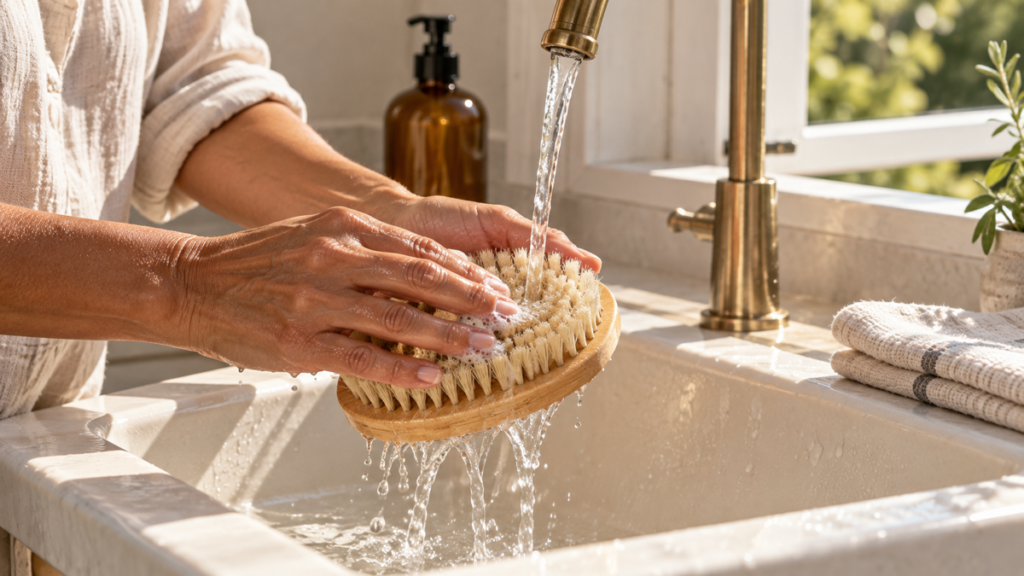
Follow the maker’s cleaning instructions because wood, detachable heads, and synthetic materials tolerate water differently. If the head can be washed, use mild soap, rinse well, shake out excess water, and leave it bristle-side down or on its side in a ventilated place. Do not put a damp brush into a drawer or sealed container.
Replace the brush if the bristles become sharp, permanently bent, loose, musty, or difficult to clean. A worn brush is not more effective because it feels rougher.
Common dry brushing mistakes
Treating redness as the goal
A little temporary pinkness can happen, but a bright red finish is not proof of better drainage or circulation. Use less pressure, fewer passes, or a softer brush.
Brushing irritated skin
Dry bristles add friction. They do not calm a rash, sunburn, shaving irritation, or broken skin. Skip the area until it is fully settled.
Combining too many exfoliants
Dry brushing, a body scrub, exfoliating acids, and a close shave in one session can overwhelm the skin. Choose one exfoliating method at a time.
Chasing detox or body-shaping claims
Research has not shown that dry brushing removes toxins or fat, treats swelling, or permanently changes cellulite. Temporary warmth or smoother surface texture is not evidence of a deeper structural change.
Letting the brush stay damp
Cleaning helps only if the brush dries completely. Store it in a ventilated spot away from splashing water.
FAQ
Does dry brushing help lymphatic drainage?
There is not enough direct clinical evidence to say that ordinary dry brushing improves lymphatic drainage in healthy people. It can exfoliate the skin, but it is not the same as manual lymphatic drainage and should not be used as a treatment for swelling or lymphedema.
Should you dry brush before or after bathing?
Before bathing is the simplest option because both your skin and brush need to be dry. Rinse afterward if you like, then apply moisturizer. If bathing first leaves your skin damp, wait until it is completely dry before using the brush.
How long should a dry brushing session take?
Three to five minutes is enough for a simple beginner routine. There is no proven benefit to turning it into a long daily session. Two or three light passes per area are plenty.
Keep your first session deliberately small
Try one lower leg before your next bath. Make two light strokes, check the sensation, and stop there. If your skin feels calm later, expand to both legs or add your arms next time.
That small test tells you more than a complicated lymphatic map. Dry brushing can be a pleasant exfoliating ritual, but it does not need detox language or hard pressure to earn a place in your routine.